What to Know Before You Start
Cycling the Loire Valley has gotten complicated with all the conflicting advice flying around. So let me cut through it. This is roughly 900 kilometres of riverbank riding — Cuffy in the south to Saint-Nazaire on the Atlantic coast — and I completed it last May over ten days, averaging about 80 kilometres a day. That pace felt human. Not rushed, not lazy. Most casual cyclists take twelve to fourteen days. If you’re genuinely fit and willing to grind serious hours in the saddle, eight or nine is doable.
Late April through early June works best. September through October too. July and August are a different animal entirely — queues at the major châteaux stretch embarrassingly long, and guesthouses in small towns vanish off booking platforms within hours of opening. I made the mistake of planning my first attempt for mid-July. Abandoned halfway. The heat, the crowds, the full guesthouses — it ground me down faster than I expected. Don’t make my mistake.
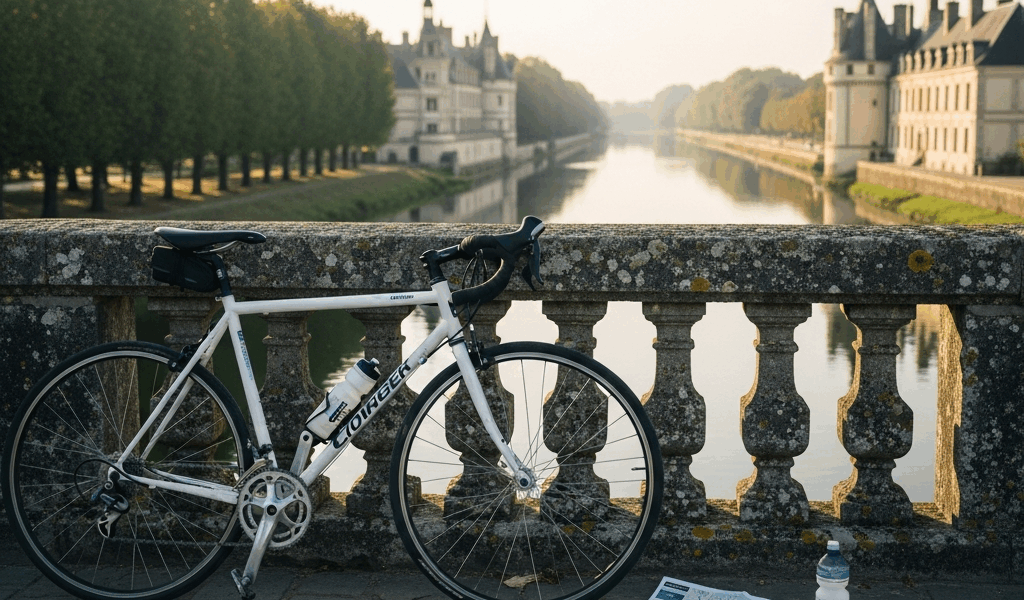
The terrain looks deceptively simple on paper. You’re following a river, so climbs are rare. But “flat” doesn’t mean smooth. Expect roughly sixty percent tarmac, twenty percent packed gravel — the powdery kind that bleeds your speed away — and twenty percent unstable river-path aggregate that’ll rattle your fillings loose if you hit it fast. A hybrid or a gravel bike handles this better than a road bike. A Cannondale Topstone or a Trek FX3 is the kind of thing I’d bring. Not a carbon racing setup.
E-bike rental exists, though not everywhere. Nantes and Tours have proper hire shops — Decathlon and Specialized models, roughly €50 a day for electric assist. Smaller towns like Amboise? Traditional bikes only. If you need electric assist for the whole route, sort it before you arrive. Availability collapses mid-season.
Key Stages and Daily Distances
Cuffy to Orléans — Around 140 kilometres over two days
Most cyclists start in Nevers rather than Cuffy — Nevers has a proper train station and the geometry makes more sense. That makes the opening stage Nevers to Orléans, which works as a single eighty-kilometre push or splits nicely across two days via Cosne-Cours-sur-Loire. Surface quality here is mostly solid tarmac hugging the river. But you’ll hit several unsigned junctions where the path forks without explanation. Download offline maps before you leave. The Loire Valley Cycle Guide app — €3.99, available on iOS and Android — saved me twice when paper signage had simply vanished.
Skip Cosne-Cours-sur-Loire unless you specifically want a break there. Working river town. No real cycling infrastructure. The stretch from Nevers to Orléans passes through genuine wine country though — small vineyards line the banks at regular intervals, which is unexpectedly pleasant.
Orléans to Blois — Seventy-five kilometres, one day
This is the route’s easy day. Tarmac nearly the whole way, well-signed, flat as a supermarket car park. Château de Chambord appears in the distance — the morning detour adds maybe ninety minutes and is worth it if your schedule allows. Orléans itself deserves a rest day. The Cathedral of Sainte-Croix alone occupies a couple of hours, and the Jeanne d’Arc museum fills the rest of an afternoon. The river embankment at dusk is genuinely good.
One warning — Blois accommodation books fast even in shoulder season. Reserve your bed before you leave Orléans in the morning.
Blois to Tours — Sixty kilometres, one day
Surface quality drops here. Gravel starts around Chaumont-sur-Loire and the path narrows noticeably. You’re deep in château country now — Amboise is visible from the route, and Château de Chenonceau sits just off the main path near the day’s end. The packed gravel section near Montlouis-sur-Loire turns waterlogged and rutted after rain. I walked it for twenty minutes rather than risk wrecking my derailleur. Worth knowing ahead of time.
Tours is the route’s psychological midpoint. Old town is walkable, restaurants are good, bike shops are everywhere. If something breaks mechanically, fix it here.
Tours to Saumur — Sixty-five kilometres, one day
Tarmac and loose gravel alternating throughout. There’s a notable section that feels genuinely isolated — no proper water stops for the first forty kilometres, so fill your bottles in Tours before leaving. Saumur’s castle dominates the arrival view. It’s spectacular, and the climb for the view is worth twenty minutes of your afternoon. The town itself runs quieter than Tours — smaller, fewer accommodation options, which some cyclists love and others find limiting.
Saumur to Angers — Fifty-five kilometres, one day
Probably should have opened with this section, honestly. This is where second thoughts arrive for a lot of people. The Loire grows wider and more tidal here — infrastructure feels noticeably less maintained than the upstream portions. Winter flooding regularly closes sections of the path, and even in summer “Inondation” closure signs appear without warning. I got rerouted twice onto road alternatives that sit outside the official route entirely. The riding is pleasant enough, but expect friction.
The gravel here stays wet and slippery even when recent rain feels distant. Walk if the surface makes you nervous. No shame in it.
Angers to Nantes — Sixty kilometres, one day
Tarmac returns. The stage passes through productive farmland — less scenic than what came before, but mentally easier to ride. Nantes rewards a full day stop. Proper city, excellent cycling infrastructure, good museums, a food scene that punches well above its size. The Machines of the Isle of Nantes — a giant mechanical elephant, a two-storey carousel of sea creatures — is genuinely strange and worth an hour of your life.
Nantes to Saint-Nazaire — Sixty kilometres, one day (optional)
Here’s where the route loses its soul. Industrial areas, aggregate quarries, port infrastructure. The tarmac is fine. The scenery is not. You’re no longer cycling through anything that resembles the France you came here to see — and the sense of achievement that’s been building for 840 kilometres quietly evaporates around kilometre thirty.
Many cyclists finish in Nantes and take the train to the coast. Thirty minutes by SNCF, €8–12, and you reach actual seaside without the industrial slog. That’s what makes the Nantes finish endearing to us practical-minded cyclists. If you do push on to Saint-Nazaire, manage expectations. The final arrival is a car park and a small sign. That’s it.
Where to Sleep Along the Route
Accommodation runs from €15 per night in gîtes d’étape — cyclist-specific bunkhouses managed by local associations — up to €80 or more in cycle-friendly hotels. Camping runs €12–20 and is plentiful; almost every French riverside town has a municipal campground within easy reach of the path.
Nevers, Orléans, Blois, and Tours have competitive accommodation markets. Mid-range options — €40–60 a night — are easy to find, and booking a few days ahead is usually enough. From Saumur onward, the market thins. Reserve two weeks in advance during summer. Small villages like Montlouis-sur-Loire and Chaumont-sur-Loire have one or two gîtes d’étape total, and they fill completely by June.
Tours onward is the real crunch zone. July or August cyclists should lock in accommodation from Tours to Nantes before leaving home. I didn’t — and spent one night in a €130 hotel because nothing else existed within a reasonable cycling radius. Expensive lesson.
Camping is your safety net throughout. Even tiny villages have a municipal site, and they’re well-maintained and cheap. Many have shower blocks and — this actually matters after three days of riding — laundry facilities.
Logistics That Catch People Out
Getting to the start
Nevers has a proper SNCF station with direct connections from Paris — roughly three hours, €40–60 depending on how far ahead you book. Bike transport on French trains costs €10 and needs a reservation. Most regional trains carry two bikes maximum, so book your bike space through SNCF’s website at the same time you buy your ticket. Don’t assume space exists on the day.
Luggage transfer
Carrying everything yourself on a hybrid bike with proper pannier racks is manageable — twenty kilograms feels doable for most people across a ten-day trip. But luggage transfer services, shuttling your bag to each night’s accommodation, run €100–150 for the full route through operators like Loire à Vélo or local taxi firms. Worth considering seriously if you have knee issues or questionable packing discipline.
Bike hire and transport
Flying in? Renting locally almost certainly beats flying with your own bike. Decathlon has outlets in Nevers, Orléans, Tours, and Nantes. A basic hybrid runs €80–120 for a full two-week rental — versus £100 or more in airline excess baggage fees, plus the genuine risk of handling damage. I’m apparently a Decathlon Riverside 500 type of person, and it worked fine for me while my friend’s mid-range road bike never really handled the gravel sections comfortably.
Flooding, the recurring nightmare
La Loire floods. Not catastrophically every year, but regularly enough that sections of the official route close with minimal warning. Check Vigilance Météo France before and during the trip — it updates daily. If major sections are closed, the Route de Secours backup is marked on official maps, but it uses busy N-roads without dedicated cycling infrastructure. Unpleasant. Workable. Not what you came for.
Carry a detailed paper map alongside your offline digital backup. That combination — a Michelin Loire Valley sheet plus OsmAnd or Maps.me downloaded for offline use — is what I’d tell anyone to bring. Phone navigation dies at the worst possible moments.
Ferry crossings
Several small ferries cross the Loire at strategic points along the route. Most are free or cost a couple of euros, and they run seasonally — summer only, typically May through September. Check ahead. A closed ferry adds ten kilometres of detour, minimum, and the road alternatives are rarely enjoyable.
How to Make the Most of the Final Stretch
The Nantes-to-Saint-Nazaire decision shapes how the whole trip feels in memory. If scenery and a sense of earned arrival matter to you, stop in Nantes. Walk through the Île de Versailles in the evening, eat excellent seafood somewhere on the Rue des Olivettes, and take the train to the coast the next morning as a separate, relaxed excursion. Anticlimactic on paper. Realistic in practice.
If you do push all the way to Saint-Nazaire, start early and build in extra time. The path runs slower than it looks, the scenery is industrial from around kilometre twenty onward, and morale dips noticeably around kilometre forty. Finish before dark — the route is unsigned in places and confusing after sunset. The SNCF journey back toward Paris via Nantes, roughly one hour to Nantes then onward, is your actual reward at that point.
So, without further ado, here’s the honest completion checklist: book accommodation from Tours onward before you leave home, download offline maps before you lose signal, confirm ferry schedules in advance, check flood forecasts daily, pack rain gear even if May looks clear on the forecast, and assume gravel sections will take thirty percent longer than your speed estimate suggests. The route is achievable for any reasonably fit cyclist. It’s not glamorous from Nantes onward — that’s just the truth. But the upstream 800 kilometres are among the finest cycling France offers anywhere.


Stay in the loop
Get the latest cycle routes world updates delivered to your inbox.