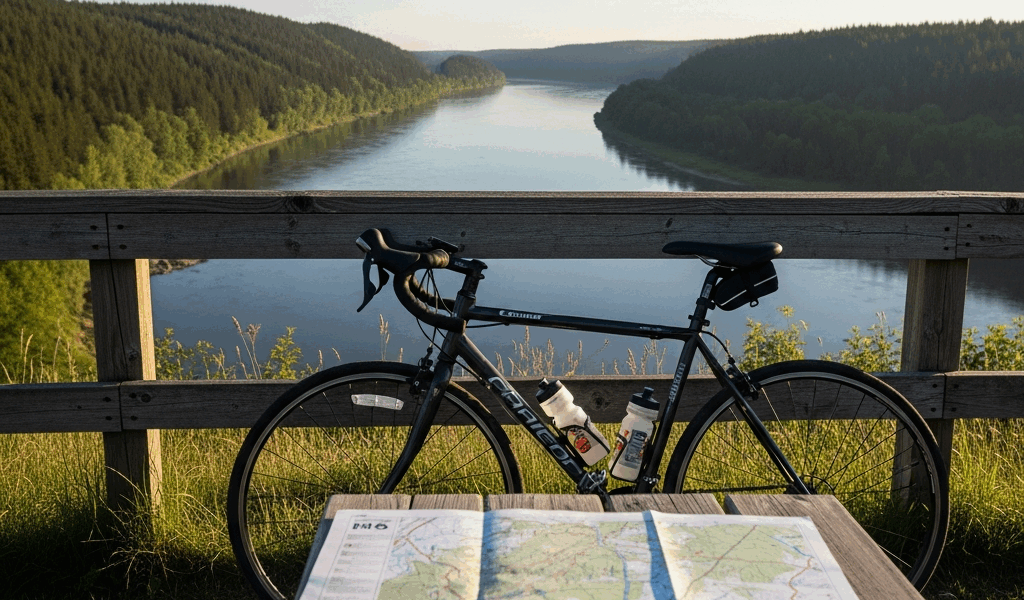
Route Overview and Key Stats
Cycling the Danube from Passau to Budapest has gotten complicated with all the conflicting advice flying around. Some guides make it sound like a casual weekend spin. Others frame it like you need a racing background just to survive. Neither is accurate. The total distance sits around 720 kilometers — far enough to feel like a real adventure, forgiving enough that you won’t need to be chasing a pro peloton to enjoy any of it.
Most riders finish in 8 to 12 days. That range matters more than it looks.
Here’s what you’re actually signing up for: the route follows EuroVelo 6, the longest EV corridor in Europe, though you’re only tackling one segment of it. The elevation profile is genuinely kind. Mostly flat, with a few rolling sections scattered through Austria that barely register as climbs. No mountain passes. No sketchy gravel descents that make you question your life choices mid-corner. This route isn’t designed to break you — it’s designed to let you drift steadily downriver while the scenery does all the heavy lifting.
Surface composition shifts throughout. Roughly 60 percent paved bike path (the Austrian sections are borderline immaculate), 25 percent compacted gravel, and 15 percent road riding where you’re sharing space with cars. Difficulty sits squarely at moderate — totally rideable on a touring or gravel bike, genuinely marginal on a road bike running 23mm tires. Don’t make my mistake on that one.
The best window runs May through September. July and August are peak season; trails fill with families, organized tour groups, and people who stop without warning. May and September offer noticeably better solitude, though water levels and weather get less predictable. I rode this in late August once and regretted the crowds almost immediately. October is technically rideable but daylight disappears early enough to cause real problems.
Quick Reference Stats Block
- Total distance: Approximately 720 km
- Surface breakdown: 60% paved bike path, 25% compacted gravel, 15% road
- Elevation gain: Under 1,000 meters total (negligible)
- Typical completion time: 8–12 days
- Difficulty: Moderate (beginner-friendly with a stamina commitment)
- Supported tours available: Yes (luggage transfer included)
- Unsupported self-guided: Yes (detailed maps required)
Segment by Segment Breakdown
Passau to Linz — 105 km
This is the warm-up, and it’s a good one. Passau sits at the corner where Germany, Austria, and the Czech Republic collide, and the ride south immediately feels like entering a postcard someone actually lived in. Surface is predominantly paved bike path — borderline perfect for the first couple of days. The Danube valley narrows here, sandwiching you between the river and forested hills. Sounds scenic, and it is, but it also means navigation barely requires thought.
Stop in Enns if your timing works — the town sits roughly halfway through the segment and has solid lunch options. Gravel surfaces start increasing near Mauthausen. Don’t panic. They’re well-maintained and honestly faster than the paved sections if you’ve got any tire clearance to speak of. One practical note: zero ferry crossings on this segment, which makes it the most logistically straightforward stretch of the entire route.
Linz to Vienna — 190 km
The long middle child. Two to three days depending on fitness. Linz itself earns a brief morning walk — the Danube promenade is genuinely interesting, not just tourist-board interesting — but the real draw here is the Wachau Valley between Melk and Krems. Terrain starts rolling properly through this section. You lose some elevation as the Danube cuts deeper into the landscape around you.
Surface conditions vary more than anywhere else on the route. Stretches between Linz and Melk are paved and fast. The Wachau section — Melk to Krems — is arguably the most beautiful riding on the entire 720 kilometers, but it’s also where path quality degrades most noticeably. Gravel, some loosely packed dirt, occasional short road sections. Probably should have opened with this segment’s accommodation situation, honestly. Melk and Dürnstein are stunning towns where rooms vanish by June, especially once July hits.
Worth flagging directly: if you’re riding this during peak season, book Wachau accommodation at least three weeks out. Alternatively, push through from Melk to Vienna in one longer day — about 115 km — and stay in cheaper, quieter towns outside the valley entirely.
Vienna to Bratislava — 60 km
Shortest segment. Most complicated. That sounds contradictory. It isn’t.
Vienna’s urban navigation is genuinely messy if you’re following the official EuroVelo routing. The path enters from the northwest, threads through industrial zones, crosses the Danube on a busy bridge near the Reichsbrücke, then has to somehow deposit you southeast toward Bratislava. Most guides gloss over this completely — I learned through firsthand mistake that signage drops off in multiple spots and GPS drift in the city center is a real, annoying problem. Surface is paved through Vienna proper, then gravel on the approach to the Slovak border.
Technically flat. Mentally exhausting. Urban navigation eats energy in a way elevation never quite does.
Practical tip: spend a night in Vienna proper. Eat well. Start early the next morning and don’t attempt to navigate the city and reach Bratislava in a single day. You’ll make errors you didn’t need to make. The border crossing between Austria and Slovakia is refreshingly simple — no fanfare, just have your passport accessible. The Danube becomes the literal border here, and the route follows the northern bank through Slovakia.
Bratislava to Budapest — 195 km
The final push. Three to four days depending on pace and how many times you stop in riverside villages — and you will stop, repeatedly.
Surface composition shifts noticeably here. More gravel, less maintained paving. Slovakia’s bike infrastructure isn’t Austria’s polished standard, but it’s genuinely fine. The riding feels less curated, more adventurous. Most people either love that or find it slightly unnerving. Both reactions are reasonable.
Landscape opens up considerably. You leave forested river valleys behind and enter the Hungarian plains. Towns get smaller, further apart. Solitude kicks in properly here. The practical reality: accommodation options thin out. Fewer hotels in smaller towns, and Radlerhotels — cycling-specific guesthouses — become rarer the further east you go. Camping becomes a realistic option, and the weather genuinely supports it from May through September.
Budapest hits you suddenly. One moment you’re pedaling through small villages; the next, you’re in a capital city. The approach is confusing — official signage is minimal — but getting turned around here carries low stakes. You’re not watching a clock anymore.
How Many Days Do You Actually Need
This answer depends entirely on what “need” means to you. Three scenarios are worth thinking through honestly.
Casual rider doing 50–60 km per day: Plan 12 to 14 days. This isn’t a slow pace — it’s a pace that lets you actually experience towns, sit by the river for an unhurried lunch, and ride without accumulating physical stress. You’ll stop properly in Enns, spend a full day in the Wachau, take a rest day in Vienna, move slowly through Slovakia. This approach works best with advance accommodation bookings and probably a luggage transfer service. Carrying all your gear at 50 km daily is fine. Carrying 18 kg of panniers at 50 km daily is punishment you didn’t sign up for.
Steady cyclist doing 80–90 km per day: Eight to nine days is realistic. You’re moving with purpose but not racing anyone. Linz on day two, Vienna on day four or five, Bratislava on day six. Requires moderate fitness — comfortable with five to six hours in the saddle — but no anaerobic effort involved. One built-in rest day, probably Vienna, keeps the grind from becoming an actual grind.
Fast-paced rider doing 100-plus km per day: Six to seven days is possible. This demands real fitness. Six to seven hours daily, potentially back-to-back, no margin for slow mornings. The risk is blowing through the Wachau’s actual appeal because your brain is locked onto kilometer targets. I’ve met riders who finished this route in five days. They completed it, took photos, and seemed mildly miserable the entire time. That’s probably not the goal.
Honest advice: don’t rush this one. The whole point is that it isn’t difficult. Build in a rest day. The stretch between Passau and Linz is genuinely the best riding on the route — don’t sacrifice it chasing a finish time.
Accommodation and Logistics on the Route
Accommodation spans a real spectrum here. Radlerhotels are cycling-specific guesthouses — mostly concentrated in Austria — that exist specifically for touring cyclists. Secure bike storage, laundry facilities, substantial breakfasts. They’re not budget options; expect 70 to 100 EUR per night. But they’re purpose-built for this kind of journey. Platforms like Komoot and dedicated sites like radlerhotels.com list them with reasonable accuracy.
Camping is genuinely viable May through September. Austrian campgrounds are excellent — 15 to 30 EUR per night, well-maintained facilities, cyclist-friendly layouts. Slovakia’s options are fewer but present. Hungary’s camping infrastructure is adequate, though quality varies more than you’d like. If you’re carrying a tent, budget roughly half your nights camping and half in budget hotels (30 to 50 EUR range) or local guesthouses.
Bike-friendly hotels exist throughout the route, though the label gets used loosely. A real bike-friendly hotel means covered storage, basic repair tools available, and no extra charge for bringing your bike inside. Many advertised as bike-friendly offer none of that. Call ahead and confirm before assuming anything.
Luggage transfer services run the full length of this route. Companies like Donauradweg and several regional operators collect your gear from your morning hotel and deliver it to your next evening’s accommodation. Costs run 15 to 25 EUR per day — sounds steep until you factor in what 15 kg of panniers does to your knees over eight days. If you’re 50-plus, running low on energy reserves, or simply don’t enjoy hauling gear, this service transforms the experience entirely.
One logistical reality worth repeating: July and August are peak season. Accommodation in Melk, Dürnstein, and the smaller Wachau towns books solid by May. Target those months and either book months in advance or plan to stay outside the valley in larger towns where availability actually exists.
The Austria-Slovakia border crossing is administratively painless. No visa requirements for EU and Schengen passport holders. Keep your passport accessible. No baggage inspections for bikes.
What to Know Before You Go
Bike hire exists in Passau if you’re flying in without your own. Expect to pay 150 to 250 EUR for a week-long rental of a proper touring or gravel bike. Bringing your own is smarter if logistics allow — you know the gearing, the fit is dialed in, and you’re not spending the first day adjusting to someone else’s saddle height. That’s a small thing until you’re 300 kilometers in.
Getting to Passau is straightforward. Munich is the nearest major airport, roughly 130 km away. Trains from Munich Hauptbahnhof to Passau run regularly — about 2.5 hours. The Passau train station sits directly on the Danube, and the cycling route starts nearby. Getting home from Budapest works the same logic in reverse. Budapest Ferenc Liszt Airport is well-connected internationally, trains back to Munich or Vienna run regularly, and bike cars on those trains handle loaded touring rigs without drama.
Bike type matters more than most guides will tell you plainly. A road bike on 23mm tires will make the gravel sections genuinely unpleasant. A gravel bike with 40 to 50mm tire clearance is the ideal setup. A touring bike works beautifully if you’re carrying gear. Mountain bikes are overkill but functional. I’m apparently a 42mm tire person and my Schwalbe G-One Allrounds work beautifully on this route while narrower options never quite feel settled on the Slovak gravel. The actual requirement: 35mm clearance minimum, geometry that doesn’t demand you stay hunched for eight hours.
Offline maps are non-negotiable. Komoot’s premium version covers the entire route and functions completely offline — download it before you board any plane. Bikemap’s downloadable maps cover this route well as a backup. Google Maps is insufficient for the smaller gravel sections in Slovakia and Hungary; it simply doesn’t have the path detail you need. Get your offline maps sorted before you leave your home country, not at the hotel in Passau.
One thing most guides skip past entirely: sections of the route near Vienna are not well-signed on the ground. The official EuroVelo routing exists on paper and in GPS databases, but physical signage gaps create real confusion for riders relying on posted markers. Keep your maps actively open through Vienna and for roughly 20 km following the city limits. This stretch isn’t dangerous — just annoying, and reliably responsible for unnecessary wrong turns.


Stay in the loop
Get the latest cycle routes world updates delivered to your inbox.