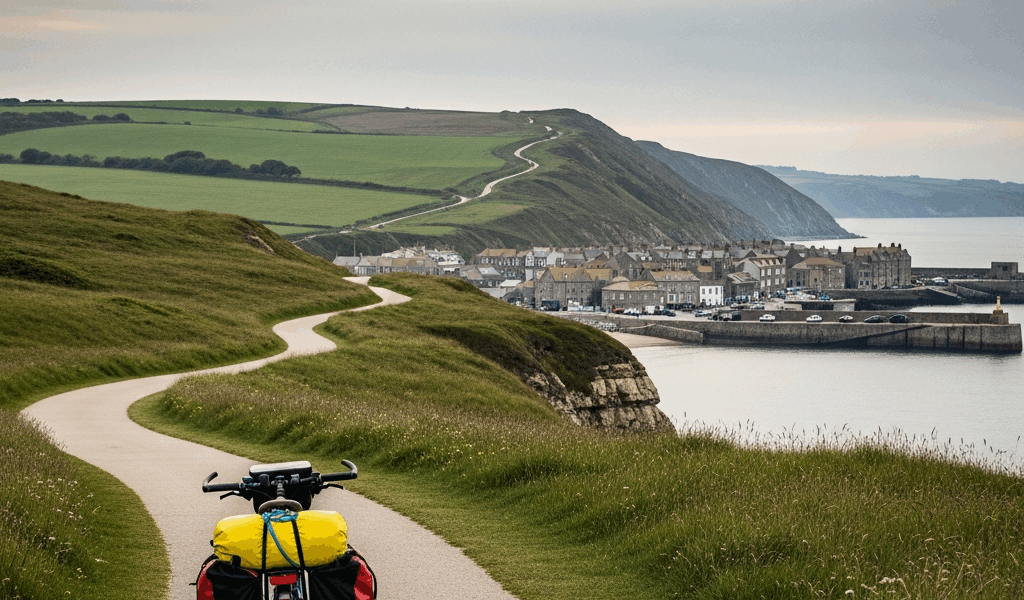
What the C2C Route Actually Looks Like
The Coast to Coast cycling route has gotten complicated with all the conflicting guides, forum arguments, and wildly optimistic itineraries flying around. As someone who cycled the C2C last summer for the first time, I learned everything there is to know about what these guides consistently get wrong — not the facts, but the feeling of what you’re actually committing to. Today, I will share it all with you.
The C2C — officially called the Sea to Sea cycle route — runs roughly 140 miles across England, west coast to east coast. But what is the C2C, really? In essence, it’s a point-to-point route through some genuinely brutal terrain. But it’s much more than that. It’s the Lake District on day one, the Pennines grinding you down by day two, and a long flat exhale into either Sunderland or Tynemouth depending on which finish variant you pick. That combination of landscape and effort is what makes the C2C endearing to us cyclists who want something earned rather than easy.
Start with the two western options, because this matters more than most guides let on. Whitehaven and Workington sit maybe 10 miles apart on the Cumbrian coast. Whitehaven wins. Every time. Around 95% of riders choose it — you roll down to the harbourside, dip your wheel in the Irish Sea, and the whole thing becomes real. Workington offers a slightly easier first day and noticeably less dramatic scenery, which is honestly exactly why nobody picks it.
Total elevation gain typically lands between 4,000 and 4,500 metres across the full route — probably higher than you’re imagining right now. The Lake District handles most of the damage across days one and two. Long, grinding Pennine ascents fill the middle section. Nothing sharp or technical, just relentless. The eastern stretch flattens considerably after Alston, and that flatness feels like someone lifted a boot off your chest.
Most intermediate cyclists finish in three to five days. Four days is the sweet spot — genuinely. Three days requires serious fitness and a willingness to suffer through 80-mile days. Five days lets you absorb the Pennines without rage-quitting somewhere near Nenthead. I’ve personally seen first-timers hammer it in three days, and I’ve also heard the quieter stories about people who stopped on day two and just — didn’t come back.
The terrain breaks down roughly like this: west coast lowlands into Keswick (30 miles, gentle with one solid climb), Lake District and Pennine approach (30 miles, steep and sustained), the Pennine crossing out of Alston (40 miles, hardest mentally), then the eastern run to the coast (40 miles, almost peaceful by comparison). Take the tarmac variant and you skip some gravel. You don’t skip the climbs.
How to Break the Route Into Daily Stages
Probably should have opened with this section, honestly. Half the difficulty of the C2C comes from scheduling, not fitness.
A practical four-day split looks like this: Day One, Whitehaven to Keswick — 32 miles, 700m elevation. Day Two, Keswick to Penrith or push further to Alston if you’re confident — 32 to 38 miles, 900m elevation. That’s the brutality day. Day Three, Alston area to Durham — 35 miles, 600m elevation. Day Four, Durham to Tynemouth or Sunderland — 35 miles, nearly flat.
Overnight stops deserve serious attention. Keswick fills up by May in any normal year — book before March if you’re travelling in summer. Penrith works as a day-one alternative if you want a gentler pace. Alston is tiny. Former lead-mining town, real charm, absolutely zero spare beds between June and August. Nenthead sits three miles before Alston and has a handful of guesthouses worth knowing about. Durham absorbs demand reasonably well, though riverside hotels spike hard in midsummer. As for finish towns — Tynemouth has better coastal drama despite the steeper final approach, and Sunderland has stronger rail connections if you just want to get home fast.
Three-day option: combine days one and two into 65 miles and 1,600m of climbing — brutal but possible — then Penrith to Durham at 70 miles — even more brutal — then Durham to the coast. Don’t do this unless you’re already touring fit. I mean it.
Five-day option: split day two into two shorter days. Keswick to Penrith is just 20 miles. Penrith to Alston is 18 miles — still hard, but manageable. It costs you an extra night’s accommodation, probably £60 to £90 depending on where you stay, but it saves your legs and — more importantly — your morale.
Day two deserves its own paragraph, full stop. You leave the lowland lakes, climb steadily for hours, hit high moorland somewhere around 600 metres, then descend into Alston. The wind up there is a different creature entirely. The views are genuinely immense and completely meaningless when you’re in your smallest gear for the fifth consecutive hour. Signage gets patchy. You’ll see maybe three other cyclists all day. Around 3 p.m. you’ll be quietly convinced you’ve gone wrong. You haven’t. You’re just on the Pennine plateau — and it goes on for a while yet.
Gear and Bike Setup for the C2C
While you won’t need a full expedition setup, you will need a handful of specific items most packing lists quietly skip over. So, without further ado, let’s dive in.
Gravel or touring geometry handles the C2C better than a road bike — but plenty of riders finish on road bikes anyway. The tarmac variant exists precisely for this reason. Stick to official Sustrans routing on a road bike and you’ll be fine. Deviate onto gravel sections and a 35mm tyre clearance minimum starts to matter. A dedicated touring or gravel bike with 38 to 40mm tyres and a longer wheelbase absorbs rough patches and luggage weight far better when you’re tired on descents.
Luggage strategy might be the best option to nail early, as the C2C requires stable weight distribution over multiple long days. That is because handling on tired legs and loaded descents is genuinely different from your usual weekend ride. Rear panniers plus a smaller front pannier keep weight low and accessible — heavier than bikepacking setups, but you can actually get into them at a café stop without unpacking everything. Bikepacking bags sit higher, shift weight during descents, and punish you for that on day two. I started with 11kg total. I regretted every gram above 8kg by the time I hit the Pennines.
I’m apparently a chronic over-packer and Ortlieb panniers work for me while lighter bikepacking setups never quite feel stable enough when loaded. Don’t make my mistake. Weigh your packed bags before you leave home. Rear panniers empty should sit around 1.2 to 1.5kg — not 2kg. Check the specs.
Brands worth trusting: Apidura, Restrap, Ortlieb. Decathlon’s own-brand luggage is solid budget kit if you’re not ready to commit to the expensive stuff yet.
Things people genuinely forget: proper waterproofs — not water-resistant, actually waterproof — chamois cream (non-negotiable past 60 miles in the saddle), a spare derailleur hanger (bent hangers end rides and the C2C has rough sections), wet wipes, and a puncture repair kit beyond just carrying one spare tube. A small saddle bag with a tool roll handles this neatly. Keep it under 2kg total.
Logistics Most Riders Figure Out Too Late
Getting your bike to Whitehaven: National Rail takes bikes on most services, but you must book a bike space in advance. These cost £3 to £5 depending on the service. Book at least a week ahead — earlier if travelling in July or August. From London, you’re typically routing through Carlisle, then connecting by bus or taxi to Whitehaven. From Manchester or Birmingham, similar story. Don’t assume there’s a space available. Book it explicitly, online or by phone.
Car shuttle option: drive one vehicle to Whitehaven, park at the town hall car park — £8 per day, genuinely safe, I left mine there four days — then cycle east. Leave your destination keys with your finish accommodation, collect them on arrival, drive back. Works cleanly for groups of two or more.
Baggage transfer services: outfits like Saddle Skedaddle move your luggage between overnight stops for roughly £5 to £10 per bag per day. First, you should consider this seriously — at least if you’re not already comfortable with loaded touring. Riding with just a small rucksack changes the whole experience, especially on day two climbs.
The C2C passport booklet: Sustrans sells it for £3. You collect rubber stamps at stops along the route. Not essential, but it motivates kids and tourists, and honestly it’s a decent souvenir. Pick one up at the Whitehaven visitor centre or order online before you go.
Signage gaps: Sustrans markers disappear without warning in sections around Alston and between Durham and the coast. Download the official C2C GPX file to your GPS unit or phone before leaving home. Phone batteries drain quickly running GPS continuously — bring a portable charger, minimum 10,000mAh. Waterproof paper printed maps work well as a backup if you prefer that approach.
What to Expect When You Reach the East Coast
Two finish options. Sunderland is flatter — genuinely better if your legs are cooked — has stronger rail connections back west, and delivers a clean, uncomplicated finish at the seafront. Tynemouth sits on a dramatic headland, has proper North Sea character, and feels more like the ending a 140-mile route deserves. The final climb into Tynemouth is steep enough to sting tired legs. It’s brief. Worth it.
The tradition: dip your wheel in the North Sea. Dozens of riders do it every week through summer. That was the Irish Sea four days ago and now it’s this. Take the few minutes. Get the photo. Eat something substantial — not a cereal bar, an actual meal.
Getting home: from Sunderland, frequent trains run south through Durham and onward to Manchester, Birmingham, London. From Tynemouth, take the Metro south into Newcastle — about 40 minutes — then catch main line services anywhere. Check Trainline or Traveline for current schedules. Book your return ticket when you book the outbound journey so you know your finish-day options before you start.
Frustrated by routes that felt either too easy or too technical, the original designers of the C2C stitched together existing bridleways, quiet roads, and old mining tracks using whatever connected west to east. This new idea took off several years later and eventually evolved into the 140-mile institution enthusiasts know and ride today. That history is baked into the route — you feel it in the old lead-mining towns, the former railway lines, the Pennine paths that predate tarmac by centuries.
Who does the C2C suit best? Intermediate cyclists who’ve knocked out a few century rides and can handle sustained climbing. First-time tourers comfortable holding 60 to 80 miles daily. Anyone who wants a route with genuinely earned views rather than gentle rolling paths. Groups after a shared challenge — hard enough to matter, not technical enough to require specialist skills. And honestly, anyone who wants to finish and say “I cycled coast to coast across England” — because you did, and that’s worth something.

Stay in the loop
Get the latest cycle routes world updates delivered to your inbox.