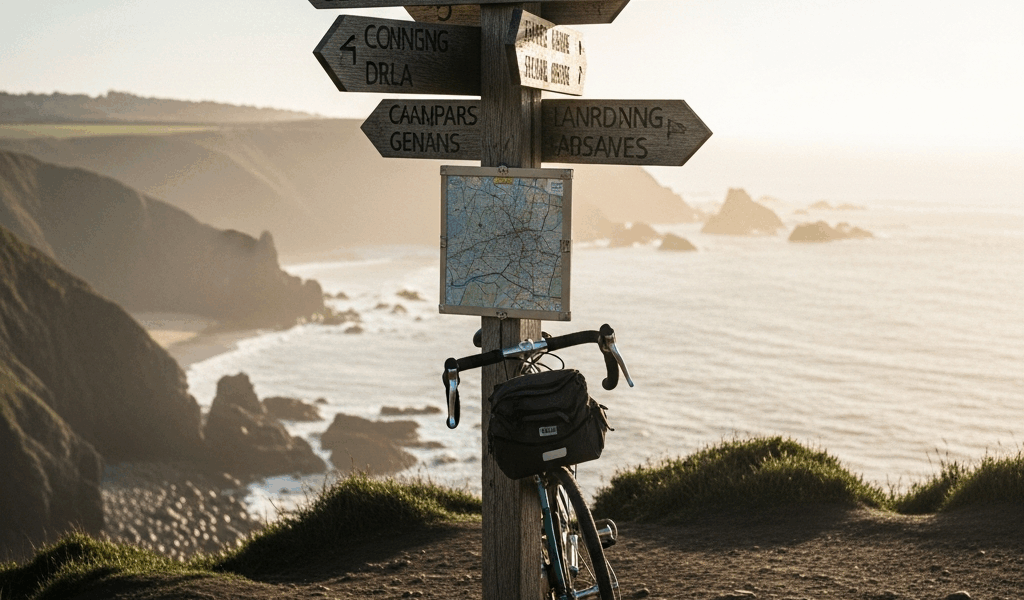
What Is EuroVelo 1 and How Long Is It, Really
EuroVelo 1 has gotten complicated with all the conflicting information flying around. Some sites quote distances that don’t match reality. Others describe sections as “family-friendly” that will genuinely wreck your knees. So let me give you the actual picture — at least the one I assembled after obsessing over this route for longer than I care to admit.
But what is EuroVelo 1? In essence, it’s a designated long-distance cycle route running the entire Atlantic coastline of Europe. But it’s much more than that. The full thing stretches roughly 8,700 kilometres — Nordkapp in northern Norway all the way down to Sagres, the southwestern tip of Portugal. To put that in terms that actually land: it’s roughly equivalent to riding London to Moscow and then halfway back again. Nine countries. Norway, Sweden, Denmark, Germany, Belgium, France, Spain, and Portugal.
Here’s what most route overviews quietly skip over — almost nobody rides the whole thing. I’ve spoken with dozens of people who’ve tackled serious sections of EV1, and I have never once met someone who pushed through from Nordkapp to Sagres in a single go. Most cyclists pick one country, maybe two. They spend 2–4 weeks on a segment, come home with a sunburn and strong opinions about French campsites, and consider it a complete success. That’s the realistic version of this route.
This guide leans hard into the southern sections — France, Spain, Portugal. Better infrastructure. Warmer riding windows. Denser accommodation networks. The Scandinavian segments are genuinely only viable June through August and demand a different level of planning entirely.
One more thing worth knowing upfront: waymarking is inconsistent in ways that will surprise you. France’s Atlantic coast sections are obsessively well-signed. Germany holds up too. Some rural Spanish stretches? You’ll be staring at your phone at every junction. The official EuroVelo GPX files exist and are free — I’d still download them — but they sometimes lag behind local reroutes by a full season. I learned this arriving at a junction in Aquitaine that had been closed for bridge repairs for months. Nobody had updated the file. Don’t make my mistake.
Key Segments and What to Expect on Each
Norway and Denmark — Arctic to Temperate
The northern anchor covers roughly 2,500 kilometres through Norway and Denmark combined. Daily distances run 40–70 kilometres depending on where you are and how your legs feel that morning.
Norway is gravel-heavy and unforgiving. Unsealed roads, river valley descents, weather that shifts every 45 minutes. Surface breakdown is roughly 60% gravel, 40% tarmac. Hard. Campsites cluster around towns, so you’re planning stops whether you want to or not. Wild camping isn’t as straightforward as people assume in Norway’s populated regions. Season runs June through August — that’s it, realistically.
Denmark is the exhale after Norway. Flat, almost entirely sealed roads, comfortable 50–60 kilometres per day. Easy. Campsites are abundant and well-marked. Quiet country roads with dedicated cycle paths woven in throughout. You can stretch the season here into May and September without too much suffering.
France — The Favourite Section
Probably should have opened with this section, honestly. This is where most EuroVelo 1 cycling actually happens, and the reputation is deserved.
The French Atlantic coast from Belgium down to the Spanish border covers roughly 1,400 kilometres of the most consistently maintained cycling infrastructure in Europe. You’re looking at 50–70 kilometres per day if you’re not chasing distance. Surface splits between dedicated véloroutes, quiet country roads, and occasional shared paths — maybe 90% sealed overall. Moderate difficulty. The route hugs the Atlantic for long stretches, which is stunning but means constant headwind exposure riding south. More on that later.
The real logistical problem in France isn’t the cycling. It’s accommodation in July and August. Campsites around Royan and Arcachon fill by noon. Hotels book weeks ahead. I watched friends scramble for tent space mid-July with no backup plan and a fully loaded touring bike. Tiny inland village hotels become your emergency option. Reserve ahead — 3–4 weeks minimum for July.
Northern Spain — Rolling Terrain Starts
The Basque Country and Galician sections run roughly 800 kilometres with noticeably more elevation than France. Daily distances sit around 50–65 kilometres, but the hills add time that the numbers don’t show.
Surface varies more than France. Better tarmac than Portugal overall, but rougher patches appear, especially on inland detours. Gravel sections show up sporadically. Moderate to hard. Accommodation thins out compared to France — fewer large sites, more small family-run places. Booking ahead stops being optional in genuinely rural stretches.
Wind character shifts here too. The Atlantic swell changes, and you start picking up resistance from the southwest rather than north. Still preferable to ride southbound, but you’ll feel it building.
Portugal — The Real Challenge
Portugal handles the final 900 kilometres down to Sagres. This is where average daily mileage drops, and for reasons that make complete sense once you’re there.
Hillier than anywhere north of it. The route weaves inland constantly to avoid motorways and urban sprawl. You’re regularly climbing 200–400 metres per day. Realistic daily distances are 40–55 kilometres — not the 60–70 you might have managed through France. Mostly tarmac with occasional gravel. Hard, partly terrain, partly the fact that you’re arriving here potentially fatigued and accommodation is spottier than anywhere else on the route.
July and August in Portugal are punishing. Full stop. April–May and September–October are genuinely superior windows — temperatures sitting around 18–22°C instead of 28–32°C. Many cyclists wild camp with landowner permission here, which works fine if you’re comfortable negotiating basic Portuguese. Campsites exist but are spaced further apart than France.
Best Time of Year to Cycle EuroVelo 1
Timing EuroVelo 1 means accepting that no single season suits the entire route. The Atlantic weather system doesn’t do one-size-fits-all.
June through August is the only viable window for Norway. Roads are clear, campsites are open, daylight runs nearly 24 hours up north. That same window, though, means July crowds on the French coast and Portuguese heat that’ll have you starting at 6am and hiding by noon.
May through September works well for France and Spain — with caveats around peak summer weeks. May is wet but manageable, crowds are light, and you can actually book accommodation without a month’s notice. September has cleaner weather and fewer tourists, though some campsites start closing late in the month.
For Portugal specifically, April–May and September–October are not just slightly better — they’re categorically better. Hills feel different at 20°C. You’re not losing water weight every hour.
One thing I genuinely underestimated: the wind direction question. Riding north to south — Norway down to Portugal — generally gives you a wind pattern that’s less brutal than the reverse. Riding south to north means fighting the Atlantic headwind for weeks on end. That might sound minor until you’re at kilometre 4,000 and a persistent headwind is costing you 10–15 kilometres of daily range. That compounds fast.
Gear, Navigation, and Route Apps Worth Using
While you won’t need a complete bikepacking overhaul, you will need a handful of specific tools and at least some thought about surface variety.
Komoot and Ride with GPS are your primary navigation tools. Both let you download entire country sections for offline use — essential in rural Spain and Portugal. The official EuroVelo GPX files are free from the EuroVelo website. Download them. Then cross-reference against Komoot’s routing, because the official files miss recent reroutes more often than they should. I’ve had to abandon a “confirmed official” route twice after local council changes hadn’t made it into the GPX yet.
Tyre width might be the best starting point, as EuroVelo 1 requires handling mixed surfaces without slowing you down unnecessarily on long tarmac days. That is because the route genuinely switches between smooth sealed roads and rougher gravel sections within the same afternoon. A 35–40mm gravel tyre on a road bike, or 40–50mm on a hybrid, handles everything well. Below 35mm gets bouncy on gravel. Above 50mm feels heavy on long sealed days.
Panniers versus bikepacking bags — both work, but differently. France’s infrastructure and frequent accommodation make bikepacking viable. Portugal’s rural stretches favour panniers. More carrying capacity for water and food between resupply points. More visible to landowners if you’re negotiating wild camping. I’m apparently a pannier person and my Ortlieb Back-Rollers work for me while frame bags have never quite suited my loading habits. Take that for what it’s worth.
Practical Tips Before You Start Planning
Three mistakes swallow most EuroVelo 1 plans before they begin.
First, you should recalibrate your daily distance expectations for Portugal — at least if you’ve based your planning entirely on the French sections. The route looks cartographically similar. The topography is not. Your comfortable 65-kilometre French day becomes a 50-kilometre grind. Budget for it or you’ll finish each day depleted and start resenting a region that doesn’t deserve it.
Second: July and August accommodation on the French coast requires reservations. Not “probably a good idea” reservations — actual advance bookings, 3–4 weeks out. Coastal campgrounds operate at full occupancy through those months. Mid-week availability doesn’t exist the way you might hope.
Third: the route is not consistently signposted. France is meticulous. Spain has dead patches inland. Portugal runs partly on local knowledge and app cross-referencing. Budget 5–10 minutes per day for navigation checks in Spain and Portugal specifically. Not because it’s hard — because the gaps are unpredictable.
That’s what makes EuroVelo 1 endearing to us route-obsessives — it resists being a fully packaged experience. But here’s what actually matters most: don’t wait until you have six months free and perfect fitness. Pick one country. France’s Atlantic coast in May is 1,400 kilometres of nearly perfect cycling — infrastructure solid, crowds light, weather workable. Portugal in spring is genuinely doable at a moderate pace. You don’t need the full 8,700-kilometre commitment to experience this route in a way that stays with you. So, without further ado, just start somewhere. Most of the people I’ve met who completed major sections started with exactly one country, one season, and no pressure about the rest. That lowered bar is probably why they actually left the planning stage.


Stay in the loop
Get the latest cycle routes world updates delivered to your inbox.