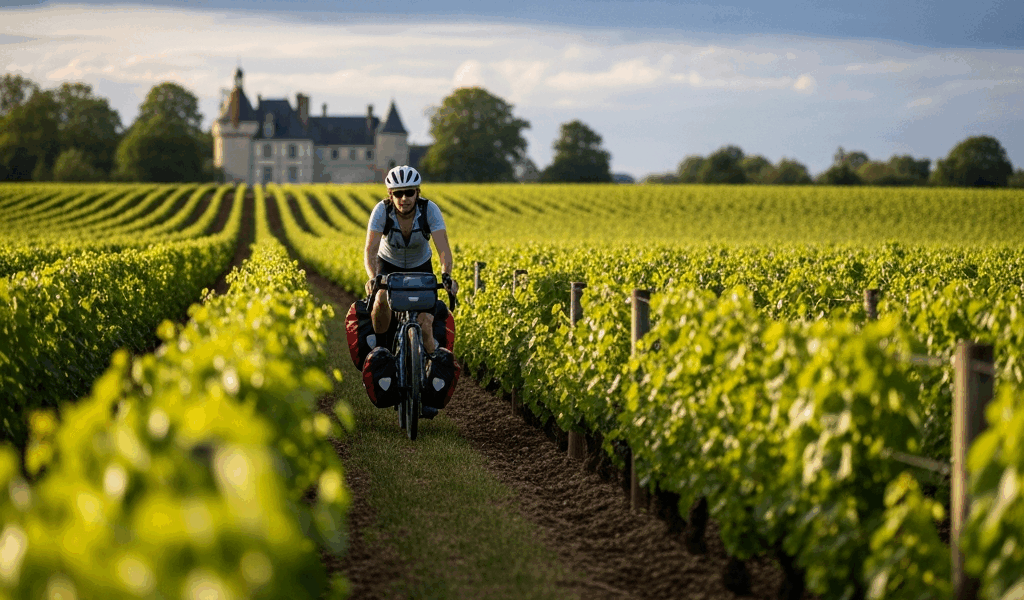
Loire Valley Cycling Route — Planning Your Ride Through French Wine Country
The Loire Valley cycling route is, without any exaggeration, one of the best bike trips you can do in Europe. I’ve ridden sections of it twice now — once in May on a rented hybrid, once in September on my own road bike shipped over in a hard case — and both times I came back wondering why more people don’t just plan this thing themselves instead of handing €3,000 to a tour operator. This guide is for the cyclists who want to figure it out independently. Not the guided-tour crowd. You.
What follows is everything I wish I’d had before my first trip: the honest route breakdown, the best weeks to go, where to sleep, how to get your bike there, and which stretch of the river is actually worth riding if you only have a week. No upselling. No “book your experience today” buttons.
The Loire à Vélo — 900 km of Flat, Beautiful Cycling
The official route runs from Cuffy, a small village in the Cher department in central France, all the way west to Saint-Brevin-les-Pins on the Atlantic coast — roughly 900 kilometers in total. It follows the Loire River for nearly its entire length, which means two things: the terrain is almost completely flat, and the scenery is genuinely extraordinary for the entire ride.
This is not a route where you earn your views by grinding up switchbacks. The Loire Valley is a wide, slow-moving river corridor with floodplains, forested islands, vineyards, and about 42 châteaux scattered along the banks. The French government and regional councils have spent decades building out dedicated cycling infrastructure here. Much of the route uses purpose-built paths along the levees — the old flood-control embankments called levées — separated entirely from motor traffic. Other sections use quiet rural roads with minimal car presence.
The route is signed as part of EuroVelo 6, the Atlantic-Black Sea corridor, but locally it’s branded as the Loire à Vélo, and that branding is everywhere. Signs are consistent, distances are clearly marked, and you’ll almost never need to pull out your phone to figure out which way to turn. I got lost exactly once in two trips, near Amboise, and that was because I ignored a sign and assumed I knew better. Lesson learned.
The UNESCO Designation — What It Actually Means for Cyclists
The Loire Valley between Sully-sur-Loire and Chalonnes-sur-Loire was inscribed as a UNESCO World Heritage Site in 2000. The designation covers the cultural landscape — the châteaux, the tuffeau stone villages, the vineyards, the river itself. For cyclists, this translates into practical benefits: the corridor is heavily protected from industrial development, which keeps the riding environment intact. You’re not going to round a bend and find a distribution warehouse. The landscape looks more or less the way it did when Renaissance kings were building pleasure palaces along these banks.
Châteaux you’ll pass or ride within a kilometer of include Chambord (the largest, with that famous double-helix staircase allegedly designed by Leonardo da Vinci), Cheverny, Chenonceau spanning the Cher River, Amboise where da Vinci spent his final years, and Villandry with its obsessively formal Renaissance gardens. Most charge between €12 and €18 for entry. Chenonceau is worth every euro of the €15 admission. Chambord is free to walk around outside, which is honestly enough — the exterior is the spectacle.
Route Surface and Navigation
The surface quality varies. The levée sections are generally packed gravel or fine crushed stone — rideable on a hybrid or a road bike with 28mm tires or wider, but not comfortable on 23mm racing tires. I used a Trek FX3 on my first trip, which was perfect. On my second trip I brought my own road bike with 32mm tires swapped in specifically for this route. The tarmac road sections are smooth and well-maintained. Avoid skinny tires.
Navigation apps: I used Komoot with a downloaded offline route. Works well. The official Loire à Vélo website also has GPX files for every section, broken down by stage. Download them before you go. Cell signal in some of the rural river sections is patchy.
The Best Sections to Ride If You Have a Week
Probably should have opened with this section, honestly, because most people reading this don’t have three weeks and 900 kilometers in them. A week gives you roughly five to seven riding days. At a comfortable 40–50 km per day — which is the pace that lets you actually stop at châteaux, sit in village squares, and drink Vouvray at lunch — that’s 200 to 350 km. Here’s how to choose your stretch.
Tours to Angers — the Classic Week
This is the section I’d recommend to almost anyone doing a first Loire trip. Tours to Angers is roughly 240 km, which fits neatly into six days at 40 km per day, or five slightly longer days if you push to 50. The terrain through here is the most consistently beautiful on the entire route — wide river views, dense château concentration, excellent wine villages, and good infrastructure throughout.
You start in Tours, which is a proper city with a functioning train station served by TGV from Paris (more on that below). From Tours you ride west through Villandry, past the gardens, through Langeais with its fortress château, into Saumur. Saumur sits on a bluff above the river with its white château visible from the opposite bank — it’s the kind of arrival that makes you feel like the trip was worth the flight already. From Saumur you continue through Gennes, Cunault, and into Angers, finishing at another imposing fortress with its famous medieval tapestry of the Apocalypse. The route ends in a city with a train station. Clean logistics.
The wine along this stretch is exceptional. Saumur-Champigny is the red to drink here — a Cabernet Franc that’s lighter than Bordeaux, mineral, slightly cooler in character. Vouvray and Montlouis-sur-Loire are the whites. Stop at a cave tasting room in Saumur and buy a bottle. Many of the wine caves are literally carved into the tuffeau cliffs along the river — the same soft white limestone used to build the châteaux.
Blois to Saumur — the Château-Dense Alternative
If châteaux are your primary motivation, the Blois to Saumur section is arguably more loaded. This stretch runs about 180 km and includes Blois, Chambord (a side trip, 17 km from the river), Chaumont-sur-Loire, Amboise, Chenonceau (another side trip, 12 km up the Cher River), and Saumur. Five major châteaux in five days. It’s a lot. Budget for entry fees — €60–80 for the big ones alone — and accept that some days you’ll cover fewer kilometers because you spent three hours inside a Renaissance palace.
Blois itself is worth an extra day at the start. The château there is often overlooked compared to its famous neighbors, but the interior is genuinely fascinating — it contains four distinct architectural wings representing four different periods of French royal history, all jammed together on one courtyard. Entrance is €14.
Shorter Options — Three or Four Days
The Amboise to Saumur section covers about 120 km. It’s achievable in three relaxed days and hits the most visually striking part of the river. If you’re combining the Loire with Paris or Normandy and can only spare a few days specifically for cycling, this is the segment to prioritize.
When to Go and What the Weather Is Like
May and June are the best months. Full stop. The days are long — sunset after 9 p.m. by mid-June — the wildflowers are everywhere along the levées, the tourist crowds at the châteaux are manageable, and the temperature sits between 18°C and 25°C most days. That’s 64°F to 77°F for American readers. Perfect cycling weather.
September is the second-best window and in some ways more enjoyable than early summer. The vendange — grape harvest — happens in September, which means the vineyards are active and the wine caves are buzzing. Temperatures are similar to June. The crowds thin out noticeably after the first week of September. The light in the Loire Valley in September has a specific quality, low and golden in the late afternoon, that photographers talk about for good reason.
July and August — Possible but Not Ideal
I’m not going to tell you not to go in July and August — plenty of people do, and they enjoy it. But the honest picture: daytime temperatures regularly hit 30°C to 35°C (86°F to 95°F), sometimes higher. The châteaux are packed. Accommodation books up months in advance and prices spike. The river path sections have no shade at all. If you’re committed to summer, start riding by 8 a.m. and be off the bike by early afternoon. Take a two-hour lunch break in a cool café. Embrace the French rhythm.
Spring Rain and Other Honest Notes
April is appealing on paper but genuinely rainy in practice. The Loire Valley gets about 65–70 mm of precipitation in April, spread across roughly 12–14 rainy days. That’s not catastrophic, but it’s enough to make several of your riding days soggy. Bring a packable rain jacket regardless of when you go — a Decathlon B’Twin cycling rain jacket costs about €30 and packs into a jersey pocket. I’ve been caught in May showers twice. You will be too.
October sees temperatures drop and some facilities — smaller chambres d’hôtes, campsite cafés, some cycle hire shops — start closing for the season. Manageable if you plan around it, but the infrastructure thins out.
Accommodation Along the Route
The Loire à Vélo has excellent accommodation infrastructure specifically designed around cyclists. You have three main categories: chambres d’hôtes, campsites, and hotels. Each works differently and suits different budgets and travel styles.
Chambres d’Hôtes — the Best Option for Most Cyclists
Chambres d’hôtes are French bed and breakfasts, typically hosted in private homes or small farmhouses. Along the Loire route, many are certified as “Accueil Vélo” — a national quality label specifically for cycling-friendly accommodation. Accueil Vélo hosts are required to provide secure bike storage, a space to clean and do minor repairs on your bike, and the ability to book you in at short notice. Look for the green bicycle logo.
Prices run €55 to €90 per room per night, usually including breakfast. Breakfast at a good chambre d’hôtes is a serious meal — fresh baguette, homemade jam, strong coffee, sometimes eggs. Factor in €10–15 per person per day for dinner. Many hosts will recommend local restaurants or cook dinner themselves if asked in advance (table d’hôte meals, typically €20–30 per person).
Booking: in May and June, two to three days in advance is usually enough. In September, same. In August, book a week ahead minimum.
Camping Along the Route
Municipal campsites appear roughly every 20–30 km along the route. Pitching a tent costs €8 to €15 per night depending on the site. Many have coin-operated showers, a basic bar or snack kiosk, and bike storage areas. The campsite in Amboise, Camping de l’Ile d’Or, is on an island in the Loire and genuinely lovely — €12 per person per night when I was there, though prices change seasonally.
Carrying camping gear adds weight. A bikepacking setup with a lightweight one-person tent (something like a MSR Hubba Hubba NX at around 1.36 kg) and a down sleeping bag rated to 10°C keeps the load reasonable. If you’re renting a bike locally, camping is harder to plan around. If you’re bringing your own bike and comfortable with the weight, it opens up flexibility and cuts your accommodation costs dramatically.
Hotels
Small towns along the route have Logis de France hotels — independently owned, inspected and rated by a national network, usually reliable for €70–€120 per night for a double room. They’re not glamorous. They’re comfortable, have decent restaurants attached, and they understand cyclists. Some of the larger towns — Tours, Saumur, Angers — have a full range including boutique options and chain hotels if that’s your preference.
Budget expectation for a comfortable self-guided week: €80–€120 per person per day including accommodation, food, and château entries. You can do it for less if you camp and cook. You’ll spend more if you eat at proper restaurants every night, which I recommend, because the food in the Loire Valley is very good.
Getting There and Getting Your Bike There
The logistics of getting yourself and a bicycle to the Loire Valley are the part most people overthink. It’s simpler than it looks.
Flying Into Paris or Nantes
Paris Charles de Gaulle is the obvious entry point for most international travelers. From CDG, you can take the RER B to Paris Gare du Nord or Paris Montparnasse and connect to a TGV train to Tours. The TGV from Paris Montparnasse to Tours Saint-Pierre-des-Corps takes about 58 minutes. Yes, under an hour. Tickets on the SNCF website run €25–€75 depending on how far in advance you book and which departure time you choose.
Nantes is the alternative — it’s the western end of the route, served by direct flights from several European cities including London Gatwick, Dublin, and various regional French airports. If you want to ride east-to-west and finish in Nantes rather than start there, flying into CDG and out of Nantes works cleanly as a one-way itinerary. No doubling back.
Getting Your Bike on the TGV
This requires attention. SNCF (French national rail) requires bikes to be either fully dismantled and packed in a bag/case no larger than 120 cm × 90 cm, or partially dismantled (front wheel off, handlebars turned) and in a bike bag. Fully assembled bikes are not permitted on TGV trains, unlike some other European rail networks.
Frustrated by this policy the first time, I ended up renting locally and have since come to consider local rental the smarter option for most riders. A standard hybrid rental from a Loire à Vélo accredited shop runs €15–€25 per day. Electric bike rental is €30–€45 per day and genuinely useful if you’re riding with a mixed-ability group or carrying heavy luggage. Detours de Loire in Tours is one of the larger rental operations — they’ll also transfer your luggage between accommodation stops for a fee if you want to ride without panniers.
Bringing Your Own Bike — When It’s Worth It
Motivated by wanting to ride my own bike with my own fit and my own components, I packed my Trek Domane AL 4 into a Scicon AeroComfort hard case (internal dimensions 140 cm × 35 cm × 85 cm, about 9 kg empty) and checked it as oversized luggage on my Air France flight. Oversized bag fee was €80 each way. The bike arrived undamaged both times. Worth it if you’re particular about your fit or planning to ride more than 7 days. Not worth it for a five-day trip where a rental will do the job.
If you bring your own bike, build in time at your arrival city to reassemble it and check everything before you start riding. I do this the afternoon I arrive and give myself a short test ride. You do not want to discover a bent derailleur hanger or a loose headset on day one of the actual route.
Luggage Transfer Services
This deserves a specific mention because it changes how you experience the ride. Several companies along the Loire route — including Detours de Loire and Loire Vélo Nature — will collect your bags from your accommodation each morning and deliver them to your next stop before you arrive. Cost is typically €10–€20 per bag per transfer. If you book your whole route in advance with your accommodation, you give them the list of stops and they handle the logistics.



Stay in the loop
Get the latest cycle routes world updates delivered to your inbox.