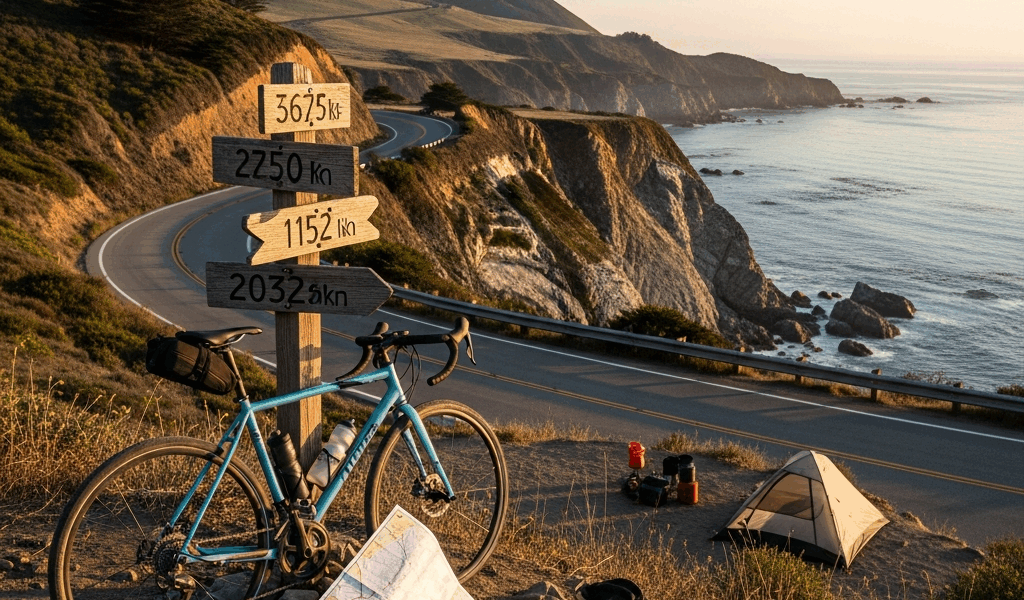
Cycling the Pacific Coast Highway Route Overview
Cycling the Pacific Coast Highway has gotten complicated with all the conflicting advice flying around. Three trips in—twice northbound out of sheer stubbornness, once southbound by actual choice—and I can tell you the third one was infinitely better than the first two combined. Today, I will share it all with you. What I wish someone had handed me before that first attempt: how to carve this thing into rideable chunks, where your head hits a pillow, what your bike absolutely needs, and the specific blunders that leave people stranded somewhere between Big Sur and the Malibu stretch wondering what went wrong.
The Pacific Coast Highway isn’t some neatly signed bikeway waiting for you. It’s a patchwork of state highways and local roads hugging the California and Oregon coastlines — best approached as one deliberate route from the Oregon border down to San Diego, or flipped. Most touring cyclists start north and push south. That’s partly romance — finishing in San Diego just feels right — and partly basic physics.
Route Overview and Key Stats
Oregon–California border to San Diego runs roughly 800 miles on the scenic routing. Tack on another 50–100 miles if you’re the type who backtracks for a beach town someone mentioned at a campfire. I’ve been that person. No regrets, mostly.
Elevation is rolling — never mountainous, never actually flat. Expect 30,000–35,000 feet of total gain depending on how many inland bypasses you take around city traffic. Big Sur, the Sonoma coast, chunks of the Bay Area — steep pitches everywhere. Southern California mellows out noticeably once you clear Ventura.
Typical finish time runs 10–14 days at 60–75 miles daily. Slower riders doing under 50 miles or taking rest days should budget 16–20 days. I once hammered it in nine days averaging 90+ miles. Don’t make my mistake. I rolled into San Diego completely fried, sat on the beach, and felt absolutely nothing. That was a waste of a finish line.
Northbound versus southbound — go south. Prevailing winds blow from the north, meaning May through September hands you tailwinds as a near-constant companion. Northbound riders grind headwinds through San Luis Obispo County and the Bay Area approaches. It’s brutal in a way that stops being character-building around day four.
How to Break the Route into Sections
Probably should have opened with this section, honestly. Five logical segments — built around resupply towns, terrain shifts, and where accommodations actually cluster — make this route manageable. Here’s how I’ve structured it after three attempts:
Segment One — Oregon Border to San Francisco (Roughly 380 miles, 5–7 days)
Drop in near Brookings, Oregon, or pick up at Crescent City, California. Humboldt County’s coastal stretch is wild and gorgeous and completely unforgiving if you’re underprepared. Eureka — your first real resupply hub — has grocery stores, delis, actual motels. Continue through Mendocino County, which stays beautifully remote all the way down. Point Arena and the town of Mendocino itself have everything you’ll need.
One logistics note that matters: reliable fog and occasional headwinds through July define this section. Pack a windbreaker even when the forecast looks clear. The ocean glare off wet pavement is genuinely brutal — 100% UV-blocking sunglasses aren’t optional here, they’re just sense.
Overnight spots cluster around state parks. Russian Gulch State Park near Mendocino charges $7 per night for hiker-biker sites. Salt Point State Park, roughly 50 miles south, runs $10. No hookups — you get a flat patch of ground, a water spigot, and an outhouse. First-come, first-served. Book nothing.
Segment Two — San Francisco to Morro Bay (Roughly 220 miles, 3–4 days)
San Francisco is a navigation headache — I’ll just say that plainly. Skip camping inside city limits entirely. Base yourself in Half Moon Bay or inland near Santa Cruz, then ride in during daylight for the photos you want. The Golden Gate on a loaded touring bike is doable — pedestrian path only, obviously.
South of the city, the route flattens through San Mateo County before climbing again around Big Sur’s approaches. Morro Bay sits 220 miles down and marks the southern edge of what I’d call “difficult terrain.” Monterey and Carmel are touristy but functional for resupply. Pfeiffer Big Sur State Park has hiker-biker camping at $7 — but it fills fast in summer. Arrive by 2 p.m. or call ahead. That’s not a suggestion.
Here’s the logistics reality nobody warns you about enough: Big Sur has essentially nothing between Pfeiffer and Cambria except pavement. That’s 65 miles with one water source — Julia Pfeiffer Burns State Park, day-use only, closes at sunset. I’ve done this stretch under-watered once. Won’t again. Carry at least 2.5 liters. Fill at Pfeiffer before you leave.
Segment Three — Morro Bay to Santa Barbara (Roughly 160 miles, 2–3 days)
The coastline straightens here. Highway 1 stays mostly rideable, occasionally nudging you inland. San Luis Obispo is a proper college town — restaurants, gear shops, laundromats, the whole package. Pismo Beach and Cambria have motels running $80–130 a night, which isn’t budget touring territory, but sometimes tired legs override principle.
Lompoc and Santa Maria offer inland alternatives that trim mileage at the cost of views. Stick to Highway 1 if your knees aren’t staging a protest. The Santa Maria to Santa Barbara stretch introduces Southern California’s wind personality — crosswinds rather than headwinds, which feels like an actual gift after Big Sur.
Segment Four — Santa Barbara to San Diego (Roughly 200 miles, 2–3 days)
This is the home stretch. Ventura, Malibu, Long Beach — all bikeable via Highway 1 or parallel surface streets. Camping effectively disappears here. State parks give way to county regional parks running day-use only. Budget for motels. La Jolla into San Diego runs dense suburban, but San Diego County parks do have hiker-biker spots scattered through.
Malibu to Ventura is 45 exposed miles — hillside chaparral, no reliable water except what you’re carrying. Start early. Finish before 3 p.m. if riding in full sun through that stretch doesn’t appeal to you. It shouldn’t.
Where to Sleep Along the Route
Your accommodation choice controls budget, daily pace, and how much flexibility you carry. Hiker-biker campsites run $5–15 per night at state and county parks. Basic — ground, water, outhouse — and you’re sharing the space with whoever shows up. Sometimes that’s lovely. Sometimes someone’s playing music at midnight.
Coastal motels run $75–150 for a double, cheaper inland. Mendocino motels skew expensive. Eureka is significantly more reasonable. Cambria and Morro Bay land mid-range. Southern California prices climb as you move south.
Book state parks 30 days out if you’re traveling July through August. I once arrived at Prairie Creek Redwoods fully booked with maybe 20 miles of usable daylight left — ended up pushing into Crescent City at dusk, sweating through a motel check-in. Use ReserveCalifornia.com or call each park directly.
The Big Sur bottleneck is genuinely real. Pfeiffer has 30 hiker-biker spaces. In summer they’re gone by 1 p.m. Arrive early, wild-camp illegally like half the touring cyclists do, or stay in Carmel and absorb the extra mileage next morning. Carmel motels start around $200. I’m apparently the type who’d rather pedal an extra 20 miles than spend $150 on a mattress — and that math works for me while the motel option never quite sits right.
What to Carry and What to Leave Home
Coastal California isn’t cold. But it is wet. Three layers handle it: a breathable rain jacket — Patagonia Houdini or LL Bean equivalent, around $99–149 — a merino or synthetic base layer, and a wind shell. You will use all three. Probably on the same day somewhere north of Mendocino.
Sunscreen and lip balm at SPF 50 or higher. Salt spray amplifies UV reflection off the water and pavement both. I torched my lips touring the Oregon coast in May and spent an uncomfortable week paying for it. Specific product that actually holds up: zinc oxide stick sunscreen from Sun Bum or Coppertone Sport. Gel formulas wash straight off in salt spray — don’t bother.
Tire width: 32–40mm is the range for this route. Pavement is generally decent, but coastal roads collect gravel and blown sand constantly. A 35mm tire on a gravel-capable road bike hits the sweet spot. Schwalbe Marathon Plus or Continental Travel Contact — both touring standards, both proven — are what I’d spec without hesitation.
Cargo capacity: 18–25 liters depending on whether you’re camping or moteling. Two rear panniers handle it. Ditch the smartphone-only navigation setup — bring a AAA California paper map and download offline maps as backup. Phone GPS disappears in canyons without warning.
Leave home: full camping kit if you’re primarily moteling. Stove, tent, sleeping bag — that’s roughly 8 pounds of dead weight. For locks: cable locks stop nobody. Bring a U-lock — something like a Kryptonite Evolution Mini-6 — for the frame. Wheels you either remove when stopped or accept the risk.
Common Mistakes and How to Avoid Them
Late August departure is a trap. The season compresses fast. Coastal storms show up without much warning. I’ve ridden Big Sur in 45-degree rain during early October when the forecast confidently predicted sunshine. Go June through early August — that window is reliable.
Underestimating Big Sur’s 65-mile service gap is the classic error. You will believe you have sufficient water. You won’t. Fill at Pfeiffer. Fill again at Julia Pfeiffer Burns if it’s open. Carry 3 liters minimum. A rider I met on my second trip ran dry between Pfeiffer and Big Sur Station, walked his bike four miles to a ranger station, and sat there miserable for an hour waiting for a refill. That was 2009. He still brings it up.
Routing via Google Maps hands you highways that are either illegal to cycle or genuinely dangerous. Use Adventure Cycling Association’s PCH route maps — around $15 for the set — or CycleRoute.org and local touring forums. Reddit’s r/bicycletouring has contributors who know this specific route in exhausting detail.
San Francisco — do not navigate it unprepared. Download SF Bike Coalition’s route map before you arrive. Protected lanes exist, but city drivers aren’t anticipating a loaded touring bike materializing in their door zone. I cut through the Mission District once and nearly got doored twice in six blocks. Market Street and the Embarcadero. That’s the move.
Cycling the Pacific Coast Highway route becomes genuinely manageable the moment you stop treating it as one enormous epic and start treating it as four or five short trips connected by pavement. Each segment is 50–100 miles — an afternoon if your bike is loaded and your legs have found their rhythm. That framing works. Everything else is just logistics.

Stay in the loop
Get the latest cycle routes world updates delivered to your inbox.