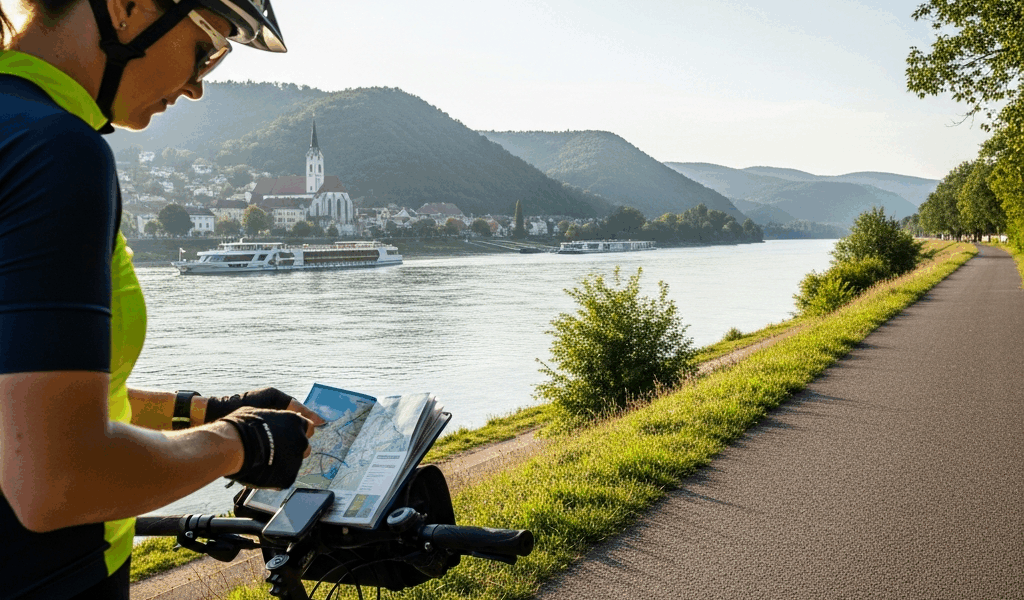
Cycling the Danube River Path — Planning Guide
Cycling the Danube River path has gotten complicated with all the guided tour marketing flying around, making it sound like something you need to pay €2,000 and wear a matching polo shirt to accomplish. You don’t. I rode the full Passau to Budapest stretch three separate times — the first completely underprepared, the second obsessively over-prepared, and the third somewhere in the middle, which is honestly where you’ll land if you read this before you go. Around a million cyclists tackle various sections every year. Independent budget travellers are still outnumbered by guided groups at every Wachau viewpoint. That gap is worth closing.
Passau to Vienna — The Classic Section
This is the one everyone talks about. The roughly 320-kilometre stretch from Passau — right on the German-Austrian border — down to Vienna is the most developed, most signposted, most cycled section of EuroVelo 6 through this region. Around 600,000 cyclists complete some or all of it each year. The infrastructure shows. So do the crowds.
The trail hugs the river through the Wachau Valley, a UNESCO World Heritage stretch that genuinely looks like someone dropped a film set into the Austrian countryside — vineyard terraces, ruined castles on every second cliff, apricot trees in bloom if you’re there in April. The Wachau section alone, roughly between Melk and Krems, is worth the entire trip. That’s what makes this stretch endearing to us independent cyclists who keep coming back despite the tour groups.
Timing — Before June Is Non-Negotiable
Go before June. I mean that seriously. I rode a section in late July and spent two days navigating around tour groups that had essentially parked themselves across the entire trail width for photo stops — panniers spread everywhere, guides gesturing at castles. May is ideal. The apricots are in blossom around the Wachau, temperatures sit between 15–22°C most days, and accommodation prices haven’t hit their summer peak. April works too but you’ll catch more rain, and riverside paths occasionally flood after snowmelt. September is a decent shoulder season alternative, though the days shorten fast and evening availability at smaller guesthouses drops off quickly.
The official Donauradweg is marked with blue-and-white signs throughout Austria and is genuinely hard to get lost on. That said — there are two riverside options in several stretches, one on each bank, and the quality varies. The south bank between Linz and Grein is quieter and better surfaced than the north in that section. Worth knowing before you commit to a side.
Where to Sleep Between Passau and Vienna
The classic overnight stops are Engelhartszell, Linz, Grein, Melk, Krems, and then Vienna. That breaks into roughly 50–70km days depending on your fitness — comfortable touring pace. Camping along this stretch is excellent. Designated cycle-tourist campgrounds appear almost every 30km, most charging between €8–14 per person per night for a pitch and shower access. Gasthof-style rooms run €45–75 for a double, often including breakfast — a proper spread in Austria, not a sad bread roll.
Probably should have opened with this section, honestly. The Passau to Vienna stretch is where most people should start planning because it sets expectations for everything downstream. Infrastructure quality drops noticeably once you cross into Hungary, and if you begin with that stretch you’ll either be pleasantly surprised or deeply frustrated depending on your temperament.
Vienna to Budapest — Less Crowded
The 285 kilometres between Vienna and Budapest is a different animal entirely. Fewer cyclists, longer distances between services, signposting that can be charitably described as “optimistic” in the Hungarian sections. I loved it more than the Austrian stretch — which I genuinely wasn’t expecting.
The Austrian side — Vienna down to Bratislava, around 80km — is still well-marked, passing through the flat floodplain of the Nationalpark Donau-Auen. Not dramatic scenery, but peaceful in a way the Wachau isn’t, especially in early morning before the day-trippers appear. Bratislava itself is deeply underrated as a lunch stop. The old town is compact, the food is cheap by Western European standards, and you can leave your bike locked outside a café without the low-level anxiety you’d feel in Vienna or Budapest.
Hungarian Signposting — What to Expect
Once you cross into Hungary, the EV6 markers become sporadic. Not nonexistent — around Esztergom and the Danube Bend, the route is clearly marked and beautifully maintained. But there are also stretches where the last sign you saw was 15km ago and Google Maps is routing you down a gravel farm track that may or may not connect to anything useful. Don’t make my mistake.
Frustrated by a wrong turn that added 22km to my day outside Komárom, I started navigating with Komoot — Hungary maps downloaded offline — cross-referenced against the Danube Cycle Route GPX files available free from the EuroVelo website. That combination is now the only setup I’d recommend. Relying on a single app in Hungary is a gamble. Download the GPX, load it into Komoot or OsmAnd, and treat road signs as a pleasant bonus rather than a navigation system.
Wild Camping in Hungary
Hungary is one of the more permissive countries in Europe for wild camping. The riverside between Komárom and Budapest has several stretches of public foreshore where independent campers set up without any issue — I wild camped three nights on my Budapest trip, and the only human interaction I had was a fisherman who wanted to know if I’d seen any carp. Official campsites in Hungary charge roughly 2,500–4,500 HUF per person (around €6–12), which is already cheap. Free riverside pitches with access to clean river water for washing kit is hard to argue with.
The Danube Bend section — the dramatic horseshoe curve near Visegrád — is the scenic highlight of this entire stretch. The views from Visegrád Castle looking down over the bend are worth the 20-minute hike up from where you’ve locked your bike. Do it at sunset if your timing allows. Seriously.
Budget vs Guided Tour Costs — Actual Numbers
Let me put real figures down because this is where independent touring either convinces you or loses you.
A guided cycling tour from Passau to Budapest — luggage transfer, pre-booked hotels, support van — runs between €1,400–2,200 per person for eight to ten days, excluding flights. That’s a legitimate product. The luggage transfer alone changes the physical experience, and having someone else handle accommodation removes a genuine planning burden.
But here’s what the same trip costs going independently:
- Accommodation (mix of camping and Gasthof): €15–30 per night average across 10 nights = €150–300
- Food: €20–35 per day eating at local restaurants and supermarkets = €200–350
- Bike transport to Passau by rail (from London via Brussels, Paris, Munich): approximately €80–140 depending on booking lead time
- Train from Budapest home: €60–120
- Incidentals — ferry crossings, entrance fees, spare parts: €40–80
Total independent budget: roughly €530–990 for the full trip, excluding flights. Against a guided tour at €1,400+, you’re saving between €400 and €1,200 depending on your accommodation choices. Over ten days. That’s not a small number.
Where to Trim Further
The biggest lever is accommodation. Going full camping — tent every night — drops your costs dramatically, especially in Austria where campgrounds are well-maintained and genuinely cheap. My lowest-cost full trip came in at €38 per day all-in, camping every night and cooking breakfast on a Primus Lite+ stove — 170g, still going strong after four years. Supermarkets in Austria, particularly Hofer (the Austrian Aldi), are well-stocked enough that buying supplies for dinner and breakfast rather than eating in guesthouses every night saves €15–20 per day without any meaningful sacrifice.
One Mistake Worth Mentioning
I booked nothing in advance the first time I rode to Vienna, in late June. Wrong. Absolutely wrong. The Wachau guesthouses — particularly in Dürnstein and Weissenkirchen — fill up weeks in advance during summer because they’re serving both cyclists and wine tourists arriving by boat. I ended up in a perfectly fine but completely charmless business hotel in Krems, having spent all day mentally booking myself into an atmospheric riverside guesthouse that turned out to have no rooms left. Book the Wachau section in advance. Everything else can stay flexible.
Bike and Gear Recommendations — What Actually Works
The Danube path is paved or hard-packed gravel for roughly 85% of its length between Passau and Budapest. That number shifts by section — the Austrian stretch is almost entirely paved, some Hungarian sections are rough gravel or packed earth. The point is you do not need a mountain bike. You also don’t need a featherweight road bike.
Touring Bike vs Gravel Bike
A steel or aluminium touring bike with 35–40mm tyres is the classic choice and still the right one for this route. Something like the Surly Long Haul Trucker or the Trek 520 — proven, repairable anywhere, stable under load. I ride a Koga WorldTraveller, which is genuinely overbuilt for this route, but I already owned it. The key specification is rack mounts. You want rear panniers, full stop. A bikepacking setup with frame bags and a handlebar roll is great for singletrack adventures — for loaded touring on a gravel path where you’re stopping at shops and guesthouses, panniers are more practical and far easier to live out of day to day.
Gravel bikes work perfectly well if that’s what you have. A Specialized Diverge or Canyon Grail with 40mm tyres handles everything the Danube path throws at you. Just fit a rear rack. The Tubus Cargo is compatible with most gravel frames that have rack eyelets — at €85, it’s probably the best value load-carrying addition you can make.
Navigation — Apps That Actually Help
Three apps are worth having installed before you leave:
- Komoot — best overall for route planning and turn-by-turn navigation, with downloadable offline maps. Pay once for the region pack (around €10 per country) and you’re set.
- OsmAnd — slower interface but the offline OSM maps are excellent and free, particularly useful as a backup in areas where Komoot’s routing goes strange
- Maps.me — useful for quick lookups in towns, finding supermarkets, pharmacies, bike shops
A handlebar mount for your phone is essential. The Quad Lock system — specifically the Quad Lock Stem Mount — keeps the phone secure at speed and lets you swap it on and off in two seconds. Cheaper bar mounts work until they don’t. Losing a phone into the Danube because an £8 clamp failed over a cobblestone section in Vienna would ruin more than just the afternoon.
Kit You’ll Actually Use
A few specifics from what I actually carry — not a generic gear list someone assembled from a spreadsheet:
- MSR Hubba Hubba NX 2-person tent — 1.72kg, freestanding, packs to 20x15cm. Overkill solo but I use the extra space for kit storage
- Ortlieb Back-Roller Classic panniers (pair, 40L total) — waterproof, bombproof, expensive, will apparently outlast the bike
- Topeak Mini 20 Pro multi-tool — covers 99% of roadside repairs
- Two spare tubes (700×35 or 700×40 depending on your tyre size) and a frame pump — CO2 is faster but runs out
- Decathlon Forclaz MT500 waterproof jacket — €90, packs small, genuinely waterproof, has survived Austrian summer storms that would have defeated more expensive options
Lights deserve a separate mention. If you’re camping wild or arriving late to towns, a dynamo hub lighting system might be the best option, as longer touring days require reliable illumination without the battery management headache. That is because running out of charge on a forest path outside Esztergom at 8:30pm — having misjudged your day — is a specific and avoidable misery. The SP Dynamo PD-8X on a built wheel runs around €120 fitted. Always-on lighting with no battery anxiety is one of those quality-of-life upgrades that sounds minor until you actually need it.
The Danube route is, ultimately, one of the most forgiving multi-day cycling experiences in Europe. Flat. Well-serviced. The scenery earns its reputation. And doing it independently — sleeping when and where you choose, eating at the guesthouse that looks right rather than the one a tour operator has contracted — is a fundamentally different experience than being shepherded along in a group. Worth every hour of planning it takes to get there.

Stay in the loop
Get the latest cycle routes world updates delivered to your inbox.