
What to Expect on the Rhine Route
Planning a Rhine cycling trip has gotten complicated with all the vague, hand-wavy advice flying around. As someone who has ridden EuroVelo 15 twice — Basel to Rotterdam, full corridor — I learned everything there is to know about this route the hard way. Today, I will share it all with you.
The full EuroVelo 15 runs roughly 1,320 kilometers. River-hugging paths, quiet back roads, and the occasional gravel stretch that blindsides road-bike riders who didn’t do their homework. Most fit cyclists finish in 14 to 18 days — sustainable pace, 80 to 100 kilometers daily. Casual riders, or anyone stopping for wine tastings and castle detours, should budget three full weeks.
But what is the Rhine Route, really? In essence, it’s a signposted cycling corridor from Switzerland to the North Sea. But it’s much more than that — it’s three completely different countries, three completely different road surfaces, and three completely different relationships with the concept of “dedicated cycle path.”
Here’s the honest bit: this route is not flat. The Netherlands section near Rotterdam? Pancake. But between Basel and Mainz you’re constantly climbing in and out of river valleys. Nothing catastrophic. Enough to hollow out your legs by day four if you’ve been telling yourself this is an easy trip. Switzerland, France, and the Netherlands all deliver excellent paved cycling paths. Germany is where things get inconsistent. Hardpack gravel near Cologne will rattle your teeth and your confidence simultaneously. Bring a touring bike or gravel bike. Road bikes with 25mm tires technically survive — but only just.
Probably should have opened with this section, honestly: the EuroVelo 15 signage is reliable right up until Germany, around Cologne, where it simply vanishes. GPX files from Komoot or Ride with GPS are non-negotiable. Download everything before you leave. Mobile signal drops hard in the gorge sections, and “I’ll just find it when I’m there” is not a strategy.
Best Time to Ride and Weather by Region
May through September is your window. Outside that range you’re gambling on cold, persistent rain, and 100-kilometer days that stop being an adventure and start being a punishment.
The Upper Rhine — Basel to Mainz — is best in May and early June. Cool mornings, spring wildflowers still going, and you won’t be sharing the path with every European retiree on a rental e-bike. Temperatures sit around 15–18°C in the morning, climbing to 22–24°C by afternoon. That’s about as good as cycling weather gets.
The Middle Rhine gorge between Mainz and Cologne gets absolutely hammered in July and August. Accommodation books out weeks ahead. Crowds slow you down on the path. September is the answer — the light in that gorge in early September is extraordinary, and the tourist density drops sharply after Labor Day. That’s what makes September endearing to us slower, more deliberate riders.
The Netherlands leg is windier and genuinely wetter even in peak summer. I’ve ridden it in both July and September. September was drier — barely. Still felt like rain was 20 minutes away at all times. The flatness makes headwinds worse. In the Rhine valleys, terrain breaks the wind. On the Dutch floodplains, there’s nothing between you and whatever the North Sea is sending inland that day.
Best month overall? June. Decent weather across all three regions, thinner crowds than July and August, and the path surfaces are freshly maintained after the spring repair cycle.
Stage-by-Stage Breakdown and Daily Distances
This is where most articles wave their hands and say “just follow the river.” Not helpful. Here’s how I’d structure a self-guided 16-day itinerary — actual distances, actual problems, actual tips.
Upper Rhine — Basel to Mainz (Days 1–5)
Basel to Breisach (55 km): Flat, paved, river-adjacent. You cross into Germany almost immediately. Think of this as a confidence-builder — your legs aren’t broken in yet, and this day is gentle enough to ease them in without drama. Breisach is a walled medieval town on the French bank. Quiet, good value, and a genuine relief after Basel’s hotel prices.
Practical tip: Bike rental shops in Basel proper charge €15–20 per day. Shops in the outlying suburbs run €8–12 for the same quality. Book a week ahead if you’re arriving in June or July — they sell out.
Breisach to Strasbourg (65 km): Gentle climbing in the first 20 kilometers as the route leaves the main Rhine channel and follows smaller tributaries. You’ll cross between France and Germany three times. French sections have noticeably better signage. Strasbourg is traffic-heavy on entry but worth it. Book accommodation early — it fills fast with tourists and conference groups simultaneously.
Practical tip: The France–Germany border crossing near Strasbourg has no checkpoint — Schengen zone, completely invisible. What isn’t invisible is the abrupt shift in signage standards and road surface. Trust the GPX file. The painted arrows on the ground are suggestions at best.
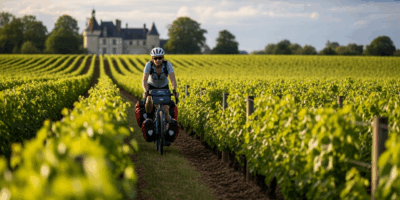
Strasbourg to Speyer (75 km): More noticeable climbing here. The route runs a few kilometers inland through wine country, paralleling but not always hugging the Rhine. Speyer is genuinely excellent — small cathedral city, cheap accommodation, and two reliable bike mechanics on the main road. Don’t rush through it.
Practical tip: Carry cash between Strasbourg and Speyer. Small-town hotels and restaurants in this stretch don’t reliably take card payment. Finding out at 8 p.m. that your guesthouse is cash-only is an avoidable problem.
Speyer to Mainz (75 km): Long but manageable. Flat, Rhine in view most of the time, good path surface. Mainz has every amenity you’d want after four days on the road. The old town is beautiful and touristy. Stay in the Kastel suburb across the Main River if you want to save €20–30 per night and still have a five-minute bridge ride to the sights.
Middle Rhine — Mainz to Cologne (Days 6–10)
Mainz to Koblenz (75 km): This is the gorge section — the one people picture when they imagine this route. Castle views start around 20 kilometers in. The path climbs away from the river frequently, breaking the monotony while adding genuine elevation. Koblenz sits at the confluence of the Rhine and Moselle. Beautiful. Very touristy. Consider staying in Braubach, 10 kilometers back, for quieter lodging and lower prices.
Practical tip: The Loreley Rock area near Sankt Goarshausen is the most photographed stretch on the entire route. Peak crowds run 10 a.m. to 4 p.m. Ride through early or late and you’ll actually enjoy it instead of weaving between tour groups.
Koblenz to Cologne (95 km): Hardest logistical day of the trip. Gravel sections hit in the Cologne suburbs. Route signage disappears entirely around Cologne-Deutz — no warning, just gone. You need that GPX file. Central Cologne accommodation is expensive and books out fast; Cologne-Nippes or Cologne-Ehrenfeld on the west side is cheaper, quieter, and has better restaurants. Or skip the city entirely and sleep in Bonn, 30 kilometers north. Less touristy, half the price.
Practical tip: Cologne’s bike theft rate is real and documented. Use a Kryptonite or ABUS U-lock — budget €30–50. Not a cable lock. Walk past any city-center bike rack and you’ll see at least one locked frame with no wheels. Don’t make my mistake.
Lower Rhine and Netherlands — Cologne to Rotterdam (Days 11–16)
Cologne to Düsseldorf (45 km): Short day, deliberately so. Path quality genuinely improves here — wide, paved, dedicated. The Rhine widens and turns industrial. Düsseldorf is wealthy and upscale. Budget accordingly for accommodation — this isn’t a budget-friendly overnight.
Practical tip: Good stop for laundry and resupply. The Markthalle covered market has fresh food. Radlager bike shop chain is here if anything needs attention before the Dutch leg.
Düsseldorf to Nijmegen (70 km): You cross into the Netherlands around Arnhem. The landscape flattens completely — immediately, visibly, almost dramatically. Wind becomes a real factor from here. Nijmegen is the oldest city in the Netherlands, small enough to feel genuine, large enough for good food and bike-friendly lodging. Dutch hospitality is noticeably better than German hospitality. That’s not an insult to Germany. It’s just true.
Practical tip: Dutch supermarkets — Albert Heijn, Jumbo — are more expensive than German ones. Stock up on snacks in Düsseldorf if you’re watching the budget. A €3 German bakery stop is a €6 Dutch bakery stop.
Nijmegen to Rotterdam via Utrecht (140 km over 2 days): Split this as Nijmegen to Utrecht (75 km, Day 14) and Utrecht to Rotterdam (65 km, Day 15). The direct Rotterdam route is dull — it loops away from the river and offers nothing. Going through Utrecht adds one day and gives you an actual Dutch city worth seeing. It also breaks the psychological weight of the final stretch.
Practical tip: Rotterdam is modern and sprawling. The Waterfront district is touristy and expensive. Stay in Crooswijk or Charlois on the south side — more character, lower prices, still world-class cycling infrastructure. Bike theft is rampant here too. Secure parking at train stations runs €5–10 per hour. Budget for it or bring a second lock.
Ferries, Border Crossings and Navigation Tips
Several small ferries cross the Rhine in Germany. Free or nearly free, charming, and seasonal. The Fährhaus Loreley ferry near Sankt Goarshausen runs April through October — €1.50 for a bike and rider, saves you 15 kilometers of inland backtracking. Worth it every time.
Other ferries between Bingen and Cologne appear on maps but don’t always run daily. Check with local tourism offices before building a stage around one. Frustrated by a cancelled ferry crossing, I once added 22 kilometers to an already-long day because I’d assumed “on the map” meant “reliably operating.” Bring coins or small bills regardless — card payment on small Rhine ferries is inconsistent at best.
The three France–Germany border crossings on EuroVelo 15 are invisible — no checkpoint, no hassle. What changes is road surface and signage quality. Expect gravel or rough asphalt immediately after crossing onto the German side. Every time. It’s almost impressive in its consistency.
The Germany–Netherlands border near Arnhem is equally seamless but the route character changes sharply and permanently. German paths are practical. Dutch paths are beautiful, obsessively maintained, and make you quietly furious that the rest of the route wasn’t like this.
Navigation-wise: EuroVelo 15 signs are unreliable in Germany — download GPX files from Komoot or Ride with GPS before you leave home. Organic Maps (free app) works offline and has saved me twice in dead-signal gorge sections. Phone battery at zero? Bikeline Publishing makes waterproof paper Rhine guidebooks for around €15. Old-school, genuinely useful.
Gear, Bike Choice and Packing Advice
While you won’t need a fully-loaded expedition rig, you will need a handful of specific items that make or break two weeks on the road. So, without further ado, let’s dive in.
Bike choice matters more than most guides admit. Touring bikes — 700c wheels, drop bars, rack mounts — are ideal. Gravel bikes work beautifully. Road bikes with 28mm or wider tires survive the German sections; anything narrower and you’re white-knuckling it on gravel and praying. E-bikes are overkill given the terrain, but they’re genuinely everywhere on this route now and make the trip accessible for riders who wouldn’t otherwise attempt it.
Panniers beat backpacks — at least if you’re doing more than a three-day section. A 40-liter setup, two 20-liter side panniers, is plenty for two weeks. No back sweat. No posture problems. Ortlieb Back-Roller Classic panniers run about €120 per pair and are genuinely waterproof, not “water-resistant.” The Rhine it rains. Get waterproof.
Lock: Kryptonite Kryptolok Mini or an ABUS Granit. One 5-millimeter cable lock is not enough. I’m apparently a slow learner and the Kryptonite works for me while cable locks never survived a single urban overnight. Don’t make my mistake.
Clothing is where people over-pack catastrophically. A merino wool base layer, a Patagonia Nano Puff or similar lightweight insulating mid-layer, and a thin packable rain shell covers you from May through September in all three regions. Chamois cream matters more than most beginner riders think — saddle sores at 100 kilometers per day are not a minor inconvenience. Padded shorts are non-negotiable.
Repair kit essentials: spare tube, tire levers, multitool, patch kit. Bike shops in rural Germany are not always near the path. Tubeless tires reduce flats dramatically — at least if you’re comfortable with sealant top-ups and plug repairs in the field. If you’ve never dealt with tubeless on the road, this trip is not the time to learn.
Pack light. Four pairs of cycling socks, two pairs of shorts, three jerseys, one pair of jeans for evenings, underwear, one warm layer. That’s it. Laundromats exist in every overnight town on this route — use them every two or three days. Everything beyond that list is dead weight you’ll resent by day six.
The Rhine Route is genuinely achievable for most people with a few weeks of training behind them. Treat it like a journey instead of a race. The castles, the wine villages, the moment in the gorge when the light hits the water at 7 a.m. — that’s what makes this route endearing to us cyclists who keep coming back to it. You’ll see more, eat better, and remember every kilometer.

Stay in the loop
Get the latest cycle routes world updates delivered to your inbox.