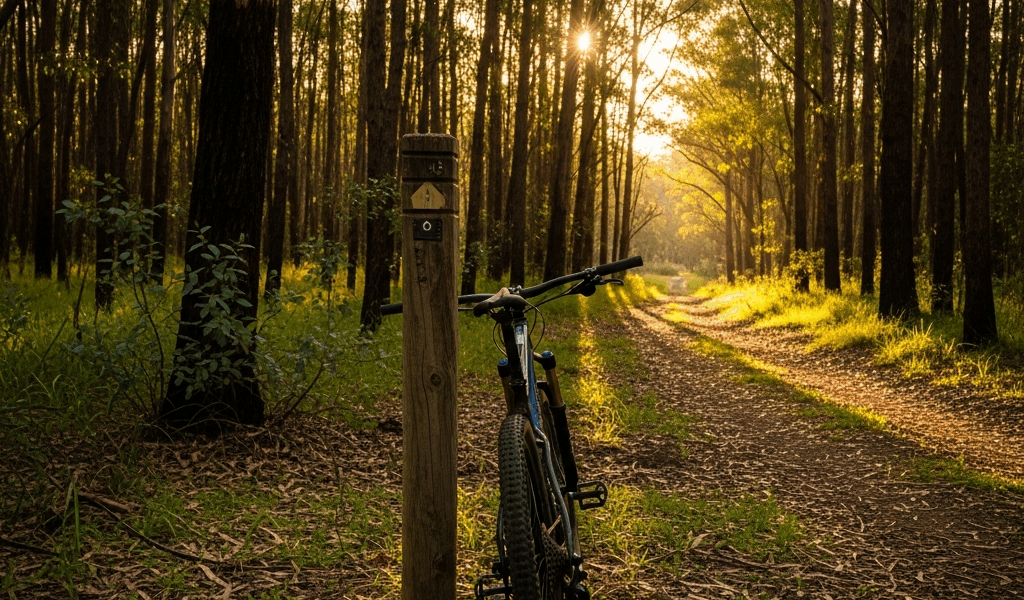
What Is the Munda Biddi Trail and Who Is It For
The Munda Biddi Trail has gotten complicated with all the bikepacking hype flying around. Everyone’s suddenly an expert. So let me cut through it — I cycled the full route in 2022, and today I’ll share everything I learned with you.
But what is the Munda Biddi Trail? In essence, it’s Australia’s longest off-road cycling route, stretching just over 1,000 kilometres from Mundaring near Perth down to Albany on the south coast of Western Australia. But it’s much more than that. It’s gravel, singletrack, technical rocky descents, muddy creek crossings, and long fire road climbs that will absolutely humble you by day three. Ask me how I know.
This is not a manicured European cycle path. Not even close. A hardtail mountain bike or a gravel bike with serious ground clearance is your baseline — at least if you want to finish with your sanity intact. Full suspension helps on the technical southern sections, though it’s not mandatory.
Road cyclists ask me constantly whether they can manage it. The honest answer is no — not safely, not enjoyably. You need at least 50mm tyres, ideally 55mm or wider. Tyre clearance matters more than most people assume going in.
Who actually rides this thing? Mountain bikers, gravel enthusiasts, and a growing wave of bikepacking adventurers. That’s what makes the Munda Biddi endearing to us off-road cycling types. The trail demands intermediate-to-advanced fitness and genuine bike handling confidence — loose descents, 80–100km days, two to three weeks of sustained effort. Many riders spend 14–21 days depending on pace and rest stops.
Expect real remoteness. Northern sections roll through farmland and state forest with scattered resupply towns. Southern sections isolate you hard — long gaps between services, patchy mobile coverage, water sources that vanish entirely in summer. Poor planning here has real consequences.
How to Break the Trail Into Manageable Sections
Breaking the Munda Biddi into four major sections makes it mentally digestible. It also helps you plan resupply timing without losing your mind over spreadsheets. So, without further ado, let’s dive in.
Mundaring to Collie — approximately 280 kilometres
This is your entry section. Mostly fire road and wide gravel track rolling through the Perth hills before transitioning into agricultural country. Most riders cover it in five to seven days, averaging 50–60 kilometres daily.
Technical difficulty is low. Hut density is relatively high. You pass through small towns regularly. Collie itself is a genuine town — supermarkets, bakeries, actual accommodation. Use this section to test your kit and fitness before the southern remoteness swallows you whole.
Collie to Manjimup — approximately 230 kilometres
Here the trail drops into karri and jarrah forest. Surfaces turn variable — technical singletrack mixed with loose gravel climbs. Water becomes less predictable. Creek crossings are common but sometimes bone dry in summer.
Four to six days is typical. Ground clearance and suspension go from “nice to have” to noticeably important. This section separates casual riders from committed ones — the climbing intensifies noticeably. Manjimup has full services, which matters enormously because the next section is a different world entirely.
Manjimup to Pemberton — approximately 250 kilometres
Probably should have opened with this section, honestly. This is the Munda Biddi’s character section. Dense forest, minimal services, proper wilderness feel. Descents are rockier. Mud is legitimately bad if you’re riding wet months. Between-hut distances stretch to 30–40 kilometres — normal here, uncomfortable if you’re unprepared.
Most riders spend five to eight days here. Running out of food or water between huts in this section isn’t a minor inconvenience. It’s genuinely uncomfortable and potentially dangerous. Don’t make my mistake — I underestimated the Manjimup stretch on my first attempt and paid for it in ways I’d rather not relive.
Pemberton to Albany — approximately 240 kilometres
The final push. Forest gives way to farmland and coastal scrub. The terrain flattens somewhat compared to the middle sections — but technical difficulty doesn’t drop proportionally. Descents stay loose and rocky right until you’re almost done.
Four to six days to Albany. Feels shorter psychologically because the finish line exists in your head now. Mobile coverage improves noticeably toward Albany. The last 50 kilometres ease off considerably — a genuine blessing after weeks of forest riding.
Huts, Campsites and Resupply Points Along the Route
The Munda Biddi Foundation manages a hut system built specifically for trail users. Simple timber shelters — roofs, walls, a sleeping platform. No bunks, no bedding, no amenities beyond basic shelter. You bring your sleeping bag and pad.
Huts are spaced roughly 30–50 kilometres apart — essentially a full day’s ride. Booking is required through the Munda Biddi Trail Foundation website or app. Fees run approximately AUD $15–20 per night. Honestly one of the trail’s genuine bargains. Campsites exist at most hut locations if the shelter itself is full.
The app might be the best option, as the Munda Biddi requires current information about water sources and closures. That is because conditions change seasonally and sometimes without warning. I’m apparently old-fashioned and downloaded PDF maps work for me while digital planning never really crossed my mind — until I arrived at a closed hut with no backup. The app showed both the closure and an alternate water source I’d have completely missed otherwise. Don’t make my mistake.
Resupply towns and distances
Towns aren’t evenly distributed along the route. Early sections are generous. Middle and southern sections have real gaps you need to plan around.
- Mundaring to Collie: Regular small towns every 20–40 kilometres. Full supermarket in Collie.
- Collie to Manjimup: Donnybrook and Bridgetown are solid stops. Manjimup has a major supermarket — stock up properly here.
- Manjimup to Pemberton: Minimal services. Long stretches between resupply points. Carry extra food — more than you think you need.
- Pemberton to Albany: Scattered small towns, then Albany handles your final resupply needs.
Water is reliable through most of the trail — creeks are common — but January through March can turn northern water sources unreliable. Carry 2-litre minimum capacity as standard practice. Purification tablets or a lightweight filter like a Sawyer Squeeze (about $40 at most outdoor retailers) reduces the anxiety considerably.
Best Time of Year to Ride the Munda Biddi Trail
The Munda Biddi has a pronounced seasonal personality. When you go dramatically shapes what you experience.
Spring — September to November
Western Australian wildflowers cover the southern sections in October and November. Spectacular isn’t an exaggeration. Weather is mild, water sources are reliable, and hut availability is competitive — book several weeks early. This is objectively the best window, which explains why it gets crowded. Expect to share huts and encounter other riders regularly throughout the route.
Summer — December to February
Heat is your primary enemy. Northern sections near Mundaring hit 35°C and above regularly. Water sources dry up. Starting south from Albany and riding north is viable, though still warm. Summer sees fewer riders — some people genuinely prefer the solitude despite the conditions.
Autumn — March to May
Excellent conditions. Mild temperatures, reliable water, easier hut availability than spring. Fewer wildflowers, but still pleasant riding throughout. This is an underrated window that deserves more attention from planners. Honestly my preferred season now.
Winter — June to August
Southern sections — particularly Manjimup through Pemberton — turn muddy when rainfall is normal. Steep descents become legitimate technical hazards. Northern sections handle winter fine. Winter appeals to riders wanting solitude and who genuinely don’t mind mud. You know who you are.
North-to-south versus south-to-north
Most riders go north-to-south — Mundaring to Albany. Easier terrain builds fitness and kit confidence before the technical southern sections test both. Spring wind patterns from the north push you southward. That’s a free assist you don’t want to give up.
South-to-north works best in summer and early autumn when northern heat becomes the real hazard. Fewer riders choose this direction, so hut booking is easier. Technical terrain hits when your legs are freshest — sensible if your skills are genuinely solid.
First-timers: go north-to-south. Plan for September through November or March through May. The progressive difficulty curve outweighs the minor wind disadvantage going south in autumn, and you’ll find a community of riders tackling the trail alongside you — which matters more than you’d think during week two.
Gear and Bike Setup for the Munda Biddi
European touring setups — rear panniers, front racks, 700c road wheels — are mistakes on the Munda Biddi. I tested a traditional pannier setup for three days before switching to bikepacking bags. The difference was immediate. That was day four of my 2022 ride, somewhere outside Collie, and I haven’t touched panniers for off-road since.
Bike choice
A hardtail with 29-inch wheels and 100–120mm of suspension travel is the sweet spot. Full suspension is comfortable on rough descents but adds weight and complexity you’ll feel every climb. Tyre clearance is non-negotiable — 55mm minimum, 60mm ideally. Gravel bikes work. Mountain bikes work better.
I’m apparently particular about my equipment and a Kona Honky Tonk hardtail (2021 model, discontinued now) works for me while traditional trail bikes never quite clicked. 60mm fork, 60mm Maxxis Minion DHF tyres. It handled everything from Mundaring fire roads to Pemberton’s rocky descents without complaint.
Tyres and pressure
Run tubeless if your rims support it — and most modern rims do. Lower pressures around 22–28 psi improve grip on loose descents and reduce pinch flats on rocks. Maxxis, Schwalbe, and Kenda all produce durable options in the right size range. Budget for spare tyres or at least two spare tubes. I had four punctures across 1,000km running tubeless, which tells you something about the surface conditions.
Load carrying — bikepacking over panniers
Frame bags, seatpost bags, and handlebar rolls distribute weight low and central. This setup handles technical singletrack infinitely better than rear panniers bouncing and destabilizing you on rocky sections. I carried 12–15kg total — camping kit, tools, spare parts, food for multi-day gaps. Bikepacking bags cost more upfront, typically $200–400 for a quality set, but they solve the actual problem rather than creating new ones.
Other essentials
- Multitool with spoke wrench — chain breaks happen, spokes bend. Both happened to me.
- Spare derailleur hanger — the Munda Biddi is unforgiving on bent derailleurs and hangers are bike-specific, so source yours before leaving Perth.
- Lightweight repair kit: patches, master chain link, spare brake cable, two sets of brake pads.
- Sleeping bag rated to 10°C minimum — southern sections are cool at night year-round, even in summer.
- Insulating sleeping pad — hut floors are concrete. Not forgiving. At all.
- Water filter or purification tablets (Sawyer Squeeze or Aquatabs are both reliable and light).
- Navigation: phone with Gaia GPS offline maps downloaded or a dedicated unit like a Garmin eTrex 32x. Mobile coverage disappears for long stretches — don’t rely on live data.
The Munda Biddi Trail is achievable, genuinely rewarding, and legitimately hard. Pick your section, choose your season carefully, get your bikepacking setup sorted, and commit to the preparation. The trail doesn’t reward shortcuts — but it absolutely rewards the riders who show up ready.

Stay in the loop
Get the latest cycle routes world updates delivered to your inbox.