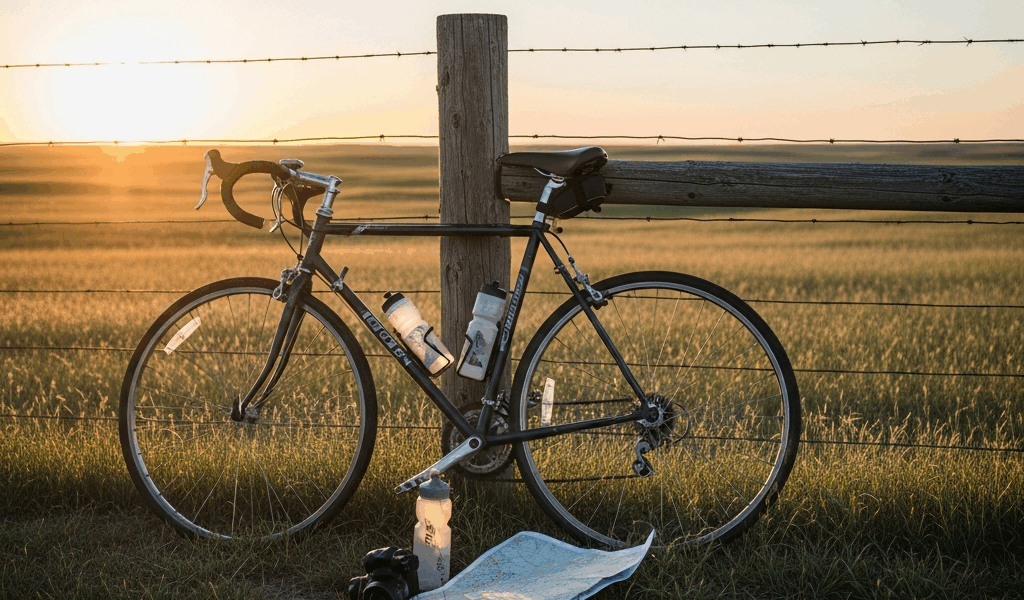
What the TransAmerica Trail Actually Looks Like
Planning a coast to coast cycling route has gotten complicated with all the conflicting advice flying around. So let me just give you the real picture, straight from the maps and the miles. The TransAmerica Trail runs 4,200 miles from Yorktown, Virginia to Astoria, Oregon. Not approximate. Not “around.” Exactly that distance — give or take a few miles depending on where you clip in and where you finally stop pedaling.
The Adventure Cycling Association designed and maintains this route, and their maps are non-negotiable. I’ve watched riders try to wing it with GPS apps and phone navigation. Don’t make my mistake. The complete map set runs about $40 — and honestly, that’s the best $40 you’ll spend on this entire trip. Those maps route you through actual towns, off dangerous highway shoulders, and onto surfaces a loaded touring bike can handle. No app does all three reliably.
The trail breaks into five segments:
- Appalachian Corridor (Yorktown to Nashville) — roughly 700 miles. Climbing. Constant.
- Midwest Section (Nashville to Kansas City) — about 1,000 miles. Rolling terrain that gradually flattens as you push west.
- Great Plains (Kansas City to Denver) — roughly 900 miles. This is the one that breaks people — mentally and logistically both.
- Rocky Mountain Spine (Denver to Missoula) — approximately 700 miles. Real climbing, thin air, services scattered far apart.
- Pacific Northwest (Missoula to Astoria) — about 900 miles. Mountainous again, then coastal.
Most riders go westbound. The reasoning is straightforward: difficult terrain hits when your legs are fresh, the easier miles come as fatigue builds, and psychologically you’re chasing the sunset instead of riding away from everything familiar. Eastbound exists and has its defenders, but roughly 80% of TransAmerica riders point their bikes west. That’s what makes the westbound experience feel like a shared one — you’re rarely alone on the road, even when you feel like you are.
How Long It Takes and How to Pace It
Probably should have opened with this section, honestly. Time is the first question anyone asks: how long does a coast to coast cycling route actually take?
It depends on your baseline fitness. A strong cyclist — someone putting down 3,000+ miles annually before departure — can finish the TransAmerica in 60 days, averaging around 70 miles daily. Most touring cyclists, the ones treating this as an experience rather than a race, finish somewhere between 85 and 95 days. If you want buffer days for bad weather, small-town detours, or mornings when your legs flatly refuse to cooperate, budget 120 days. Four months. Clear your calendar accordingly.
Daily mileage isn’t uniform across the route. Here’s what the terrain actually gives you:
- Appalachians — expect 40 to 55 miles per day. The elevation gain is real, even though the absolute heights seem modest compared to the Rockies.
- Midwest — 55 to 70 miles daily. Flatter, faster, and still genuinely beautiful in a way people don’t expect.
- Great Plains — 60 to 75 miles per day on paper, but wind makes 65 miles feel like 85. The mental toll doesn’t scale with mileage out here.
- Rockies — 40 to 60 miles per day. Altitude compounds fatigue in ways that sneak up on you. Some passes demand actual climbing fitness, not just stubbornness.
- Pacific Northwest — 50 to 65 miles daily. Varied terrain, decent road surfaces, regular services.
I made the mistake of treating “average daily mileage” as my pacing metric in week one. By day six, my body’s actual capacity had nothing to do with national averages. Commit instead to a fixed daily distance matched to your real fitness level. No competitive cycling background? Fifty-five miles is your number. Ride that number every day for two solid weeks before your departure date — if that feels unsustainable in training, you haven’t trained enough.
Start loaded tours at least eight weeks out. A single weekend tour doesn’t cut it. Two consecutive weeks with a fully loaded bike does — that’s the threshold where your sit bones stop screaming and your shoulders actually adapt to the weight distribution.
The Resupply Problem Nobody Warns You About
Every cycling forum has a thread where someone asks: “Why did nobody tell me about the food gaps in Kansas?” Someone always did. They just buried it in their own planning notes and never published it anywhere useful. So here it is.
The Great Plains section — specifically the Kansas stretch and eastern Colorado — contains segments where reliable resupply simply doesn’t exist between towns. Some gaps reach 75 to 80 miles. At touring speed, that’s five or six hours of pedaling before you hit anything resembling a grocery store. A gas station stocked with warm soda and gas station beef jerky at $18 per pound doesn’t count. You need real food: bread, cheese, vegetables, fruit, something with actual caloric density.
The stretch between Johnson, Kansas and Scott City — roughly 70 miles of dead-flat terrain — is the classic example. Oakley, Kansas sits between them, population under 2,000, with limited grocery options and hours that don’t care about your arrival time. I’ve heard from riders who calculated their arrival perfectly, found the single grocery store already closed, and spent that evening in their tent eating whatever the gas station had left. That’s what makes the Plains section so unforgiving — the logistics bite harder than the terrain.
Here’s how to navigate it:
- Increase your carrying capacity before entering the Plains. A rear rack with two panniers should hold four days’ worth of groceries: pasta, canned vegetables, peanut butter, rolled oats, nuts. Weight matters, but starvation matters more.
- Use truck stops strategically. Pilot and Love’s locations along the I-70 corridor stock hot deli food — not just candy bars. A rotisserie chicken and a bag of salad from a truck stop is a legitimate meal. Use it.
- Plan your rest days around resupply, not mileage. When you hit a real town — Garden City, Kansas, for example — treat it as your base. Restock for the next 150 miles, do laundry, sleep indoors. Don’t leave that town assuming the next stop has what you need.
- Contact the Adventure Cycling Association directly. Their route support team tracks changes in real time. Gas stations close permanently. Grocery stores relocate. Their information is fresher than any blog post, including this one.
The Rockies present a different problem entirely. Towns are spaced more reasonably — typically 40 to 60 miles apart — so availability isn’t the crisis it is on the Plains. The issue there is altitude suppressing your appetite while your body burns significantly more calories than usual. Force-feed yourself on the climb side of every pass, even when eating feels like a chore. Especially then.
Where to Sleep Along the Route
Three legitimate options: campgrounds, hosting through Warmshowers, and motels in larger towns. Each has its place.
Campgrounds run $15 to $30 per night across most of the route. KOA locations trend toward the expensive end. National Forest Service campgrounds in the West — $10 to $15 a night — offer the best value you’ll find anywhere on this trip. State parks split the difference. Bring a camp stove rather than depending on fire rings. Faster, more reliable, and your food quality goes up considerably. My standard camp dinner: pasta with canned tuna and whatever vegetables survived the day’s riding. Two pans, fourteen minutes, done.
Warmshowers.org is a hosting network built specifically for bicycle travelers. Most stays cost nothing beyond a small donation and a conversation. You get a real bed, a shower, and time with someone who actually understands why you’re doing this — which matters more than it sounds after three weeks alone on the road. Set up your profile at least a month before departure. The good hosts book weeks out. The one real downside: you’re working around someone else’s schedule when you might just want to collapse. Some nights, that trade feels lopsided.
Motels run $60 to $120 per night depending on location. Rural Kansas? Closer to $55. Portland? Expect $130 for the same quality room. Independent motels consistently undercut the chains — and they’re more likely to let a muddy bike through the front door without a lecture. The owner at the Sunshine Motel in Tribune, Kansas asked zero questions and let me roll my bike directly into the room. That kind of flexibility is worth more than any loyalty points program.
Regional patterns shape your strategy: campground density in the Pacific Northwest is genuinely impressive — sites every 20 to 30 miles in some stretches. The Midwest spaces them out to 40 or 60 miles and the quality drops noticeably. That’s where Warmshowers becomes essential. The hosting culture tends to be strongest in communities that lack dense camping infrastructure. People fill the gap.
Budget roughly $40 per night for accommodation if you rotate between camping and motels with occasional Warmshowers stays mixed in. That covers everything from the $12 Forest Service site to the $90 emergency motel night when weather turns genuinely ugly.
Best Times to Start and What to Know About Timing
The TransAmerica opens practically in late April. It closes — not officially, but in every way that matters — by late September. That’s your window.
Late April through May is the optimal launch period. Temperatures in the East are manageable, snowmelt has cleared the high passes by early June, and you arrive on the Oregon coast before autumn weather turns from picturesque to punishing. If you can only pick one window, this is it.
June still works well. Slightly warmer, slightly higher chance of running into other cyclists on the route, slightly reduced risk of late spring snow above 8,000 feet. The margins narrow but don’t disappear.
July is where timing gets conditional. An early July start puts you finishing in late October — cutting it close on mountain passes and directly into Pacific Northwest rain season. Late July departures carry genuine risk of wet snow on passes above 8,000 feet come late September. I’m apparently someone who learned this the hard way, and planning ahead works for me while improvising never does.
The Kansas heat problem deserves its own sentence. Mid-July through mid-August on the Plains means temperatures between 95 and 105 degrees Fahrenheit. Hydration becomes a job. Heat exhaustion stops being theoretical. Riders who maintained full daily mileage through peak summer heat have reported losing an entire week to dehydration-related fatigue — and it hits two to three weeks later, not immediately. The bill arrives late.
Wildfire smoke in the Pacific Northwest peaks August through September. Finishing in early October on the Oregon coast could mean visibility of 200 feet and air quality that makes breathing feel like a project. Check air quality data from late August onward before committing to a departure date — that data should actually influence your decision, not just inform it.
The practical decision framework: If July is your only option, go westbound, aim to clear the major Rockies passes by mid-September, push 70 miles daily instead of 60, and accept fewer rest days as part of the math. If your only available departure comes after August 1st, honestly reconsider the whole thing. The risk-reward ratio inverts fast. You’ll finish in a Pacific Northwest winter — wet, dark, and nothing like what you imagined at the start.
Depart in May. You’ll miss the worst crowds, dodge the worst weather on both ends of the route, and arrive with enough time to spend a week on the Oregon coast actually enjoying it instead of riding through rain with your head down.

Stay in the loop
Get the latest cycle routes world updates delivered to your inbox.